
Leading the Nation
Death of
Dr Duncan
The tragic drowning that set South Australia on a path to gay law reform

March 1972
Dr Duncan arrives in Adelaide
Starting work at the University of Adelaide
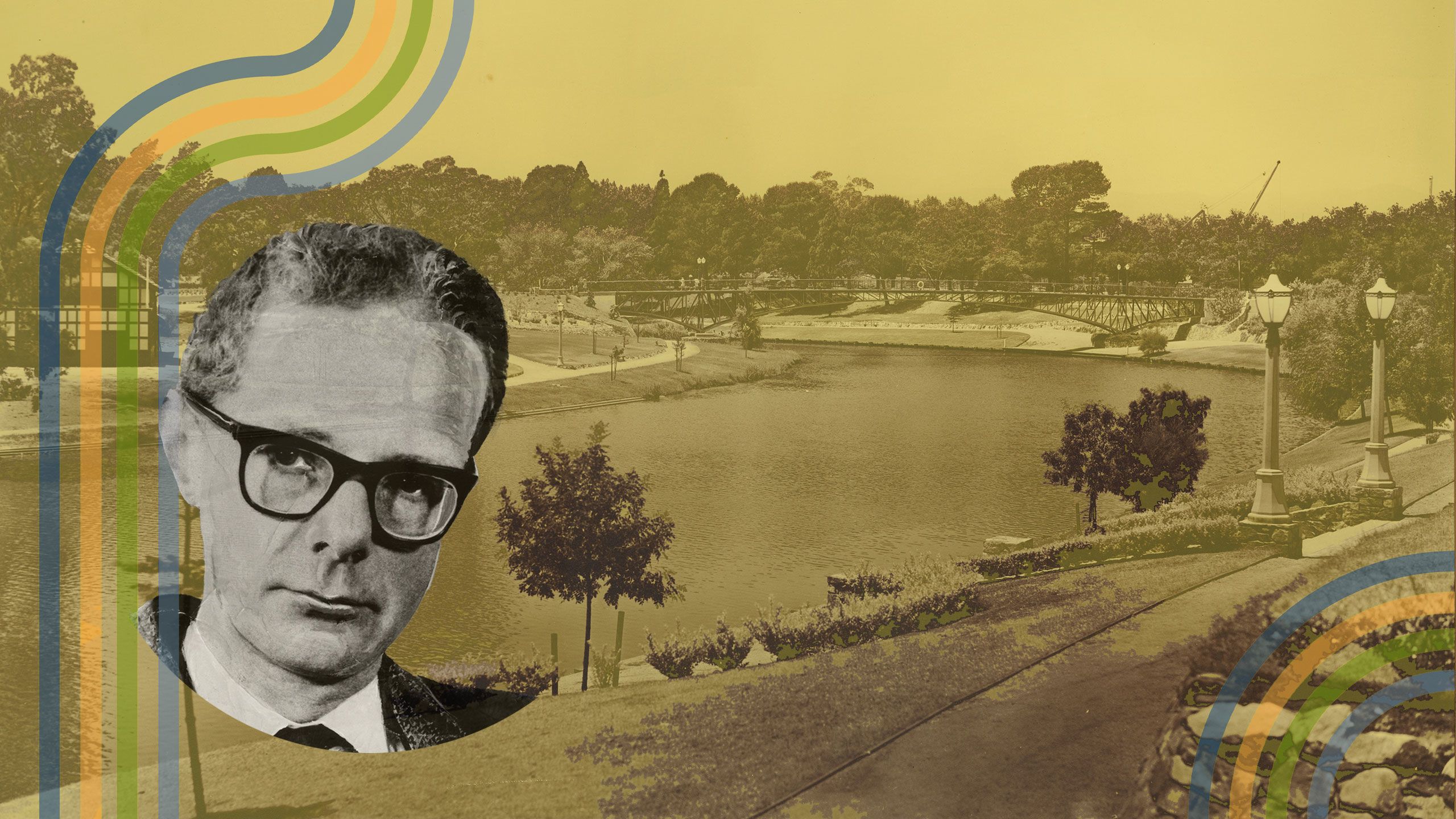
Dr George Ian Ogilvie Duncan, known as ‘Ian’, arrived in Adelaide on 25 March 1972. In two days, he would commence his new job (which he had initially turned down) as a lecturer in law at the University of Adelaide, teaching Roman law and English legal history. He would not live seven weeks.

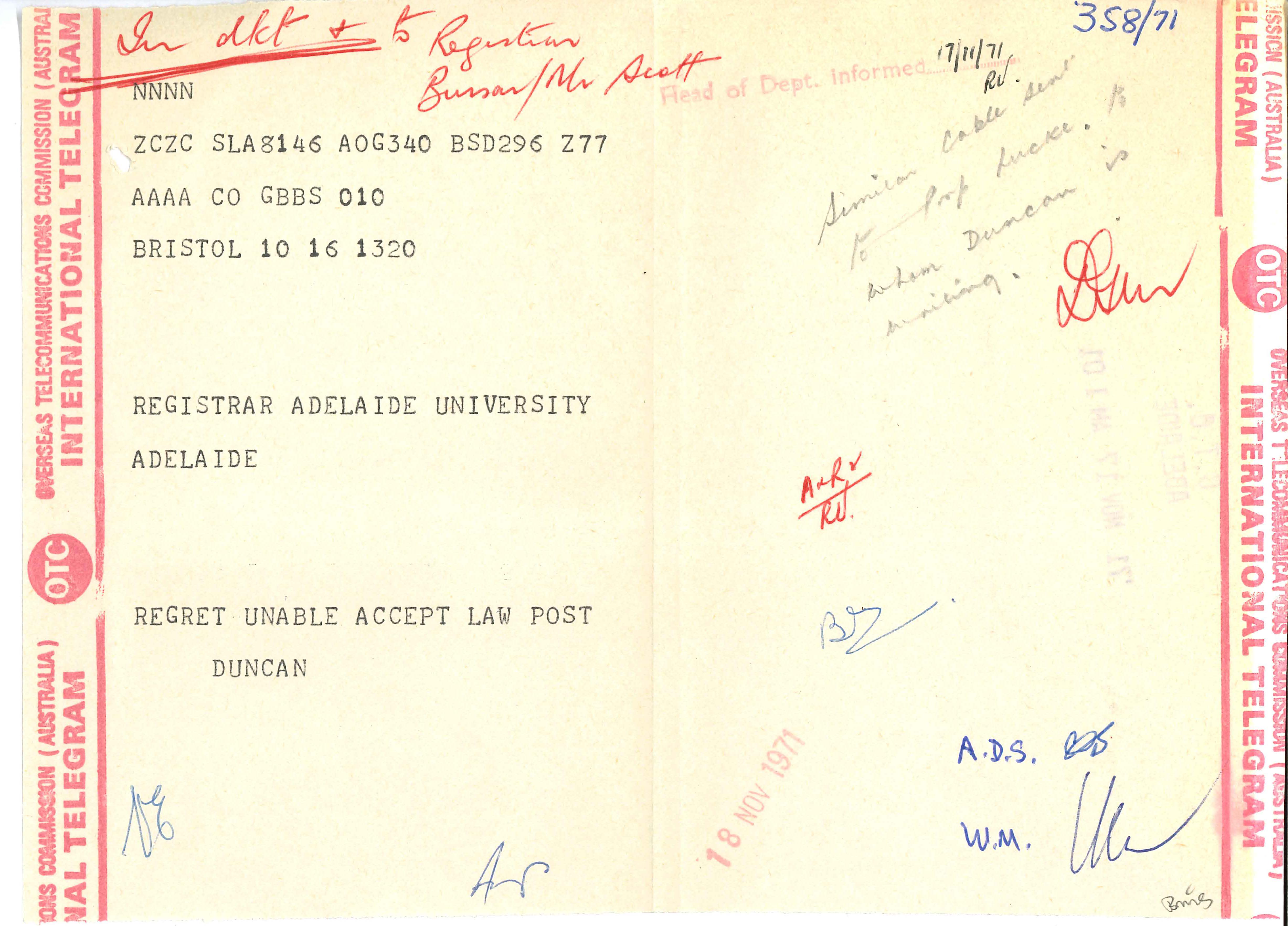
Dr Duncan’s telegram initially rejecting his job offer. University of Adelaide Archives: 1971/358
Dr Duncan’s telegram initially rejecting his job offer. University of Adelaide Archives: 1971/358
Dr Duncan’s passenger arrival card confirmed that, for the past 16 years, he had been resident in the United Kingdom. Sexual acts between men had been decriminalised in England and Wales in 1967. Dr Duncan had arrived in Australia at a time when no state or territory had adopted such legislative change, and when male homosexuality was still largely regarded with distaste or even disgust. He was 41 years old, a shy gay man who was not open about his sexuality.

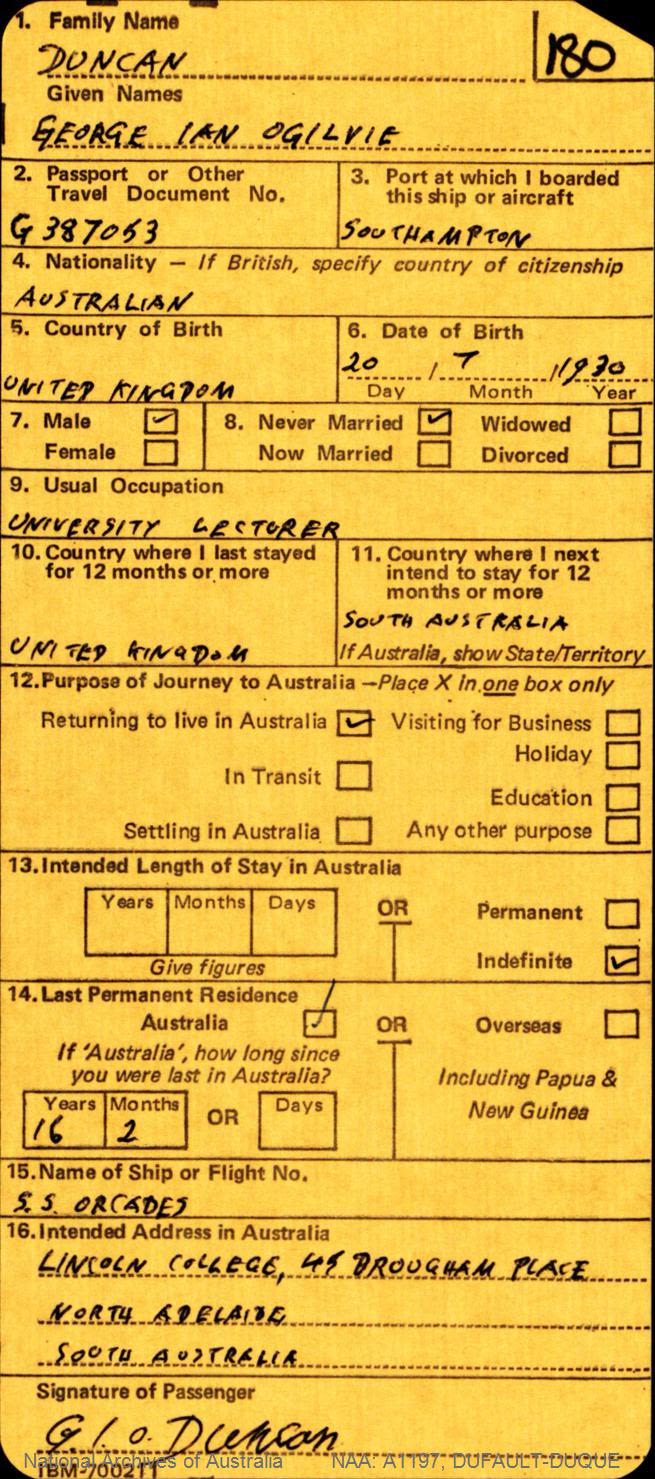
Dr Duncan’s passenger arrival card. National Archives of Australia: A1197, item ID 12422144 (jump to page 1379 and press go)
Dr Duncan’s passenger arrival card. National Archives of Australia: A1197, item ID 12422144 (jump to page 1379 and press go)
Dr Duncan brought with him copies of the international gay travel guide, Spartacus, which listed meeting places in Adelaide, including ‘Outside Cruising’ spaces like Victoria Drive. This is where he would be killed.

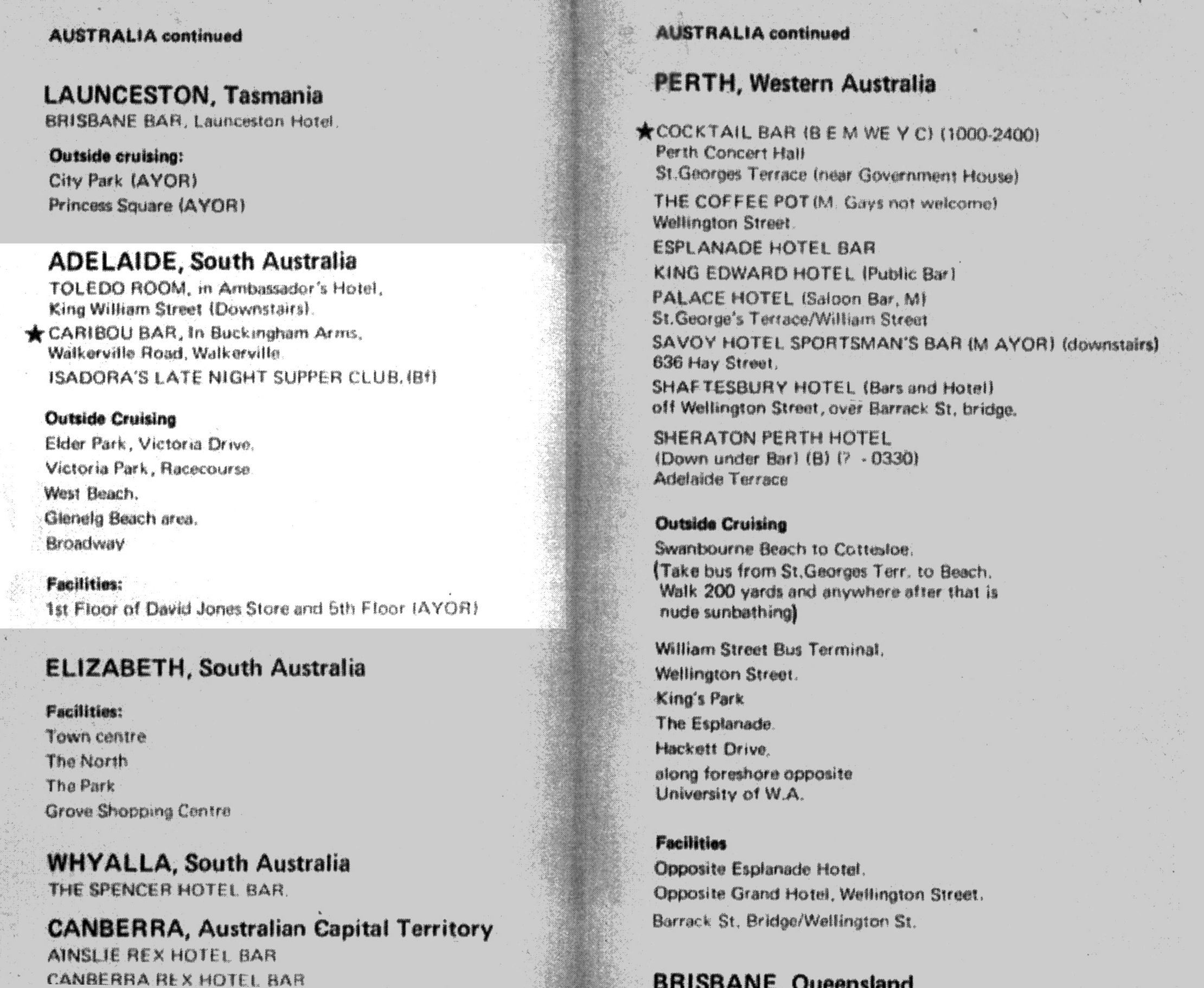
Spartacus excerpt. Courtesy Professor Kevin Markwell
Spartacus excerpt. Courtesy Professor Kevin Markwell



10 May 1972
Dr Duncan dies
Two men are attacked on the southern bank of the River Torrens
This was a 'beat', a discreet and public meeting place for men. It was policed by members of the South Australian Vice Squad, who would engage in entrapment and, shockingly, assault.
Just after 11pm on Wednesday 10 May 1972, Dr Duncan and another man, Roger James, were thrown into the river by a group of male attackers. Unable to swim, Dr Duncan drowned.

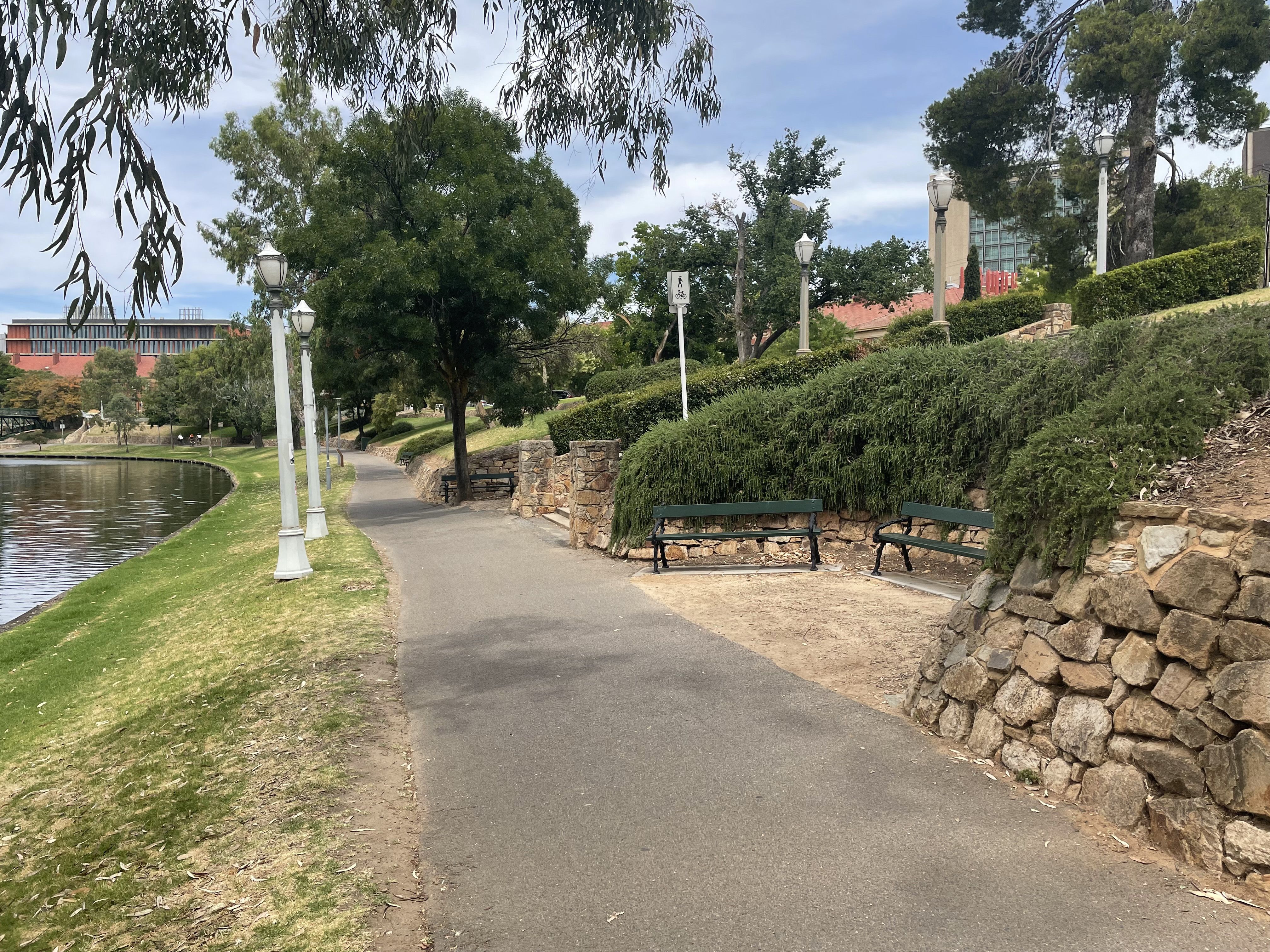
Site of attack on Dr Duncan and Roger James. Photographer Tim Reeves
Site of attack on Dr Duncan and Roger James. Photographer Tim Reeves
One of the attackers stripped down to his underpants and dived in to try and save Dr Duncan, but when he could not be found they all fled. James, who had broken his ankle, crawled to the roadside and was taken to hospital by a passing motorist.

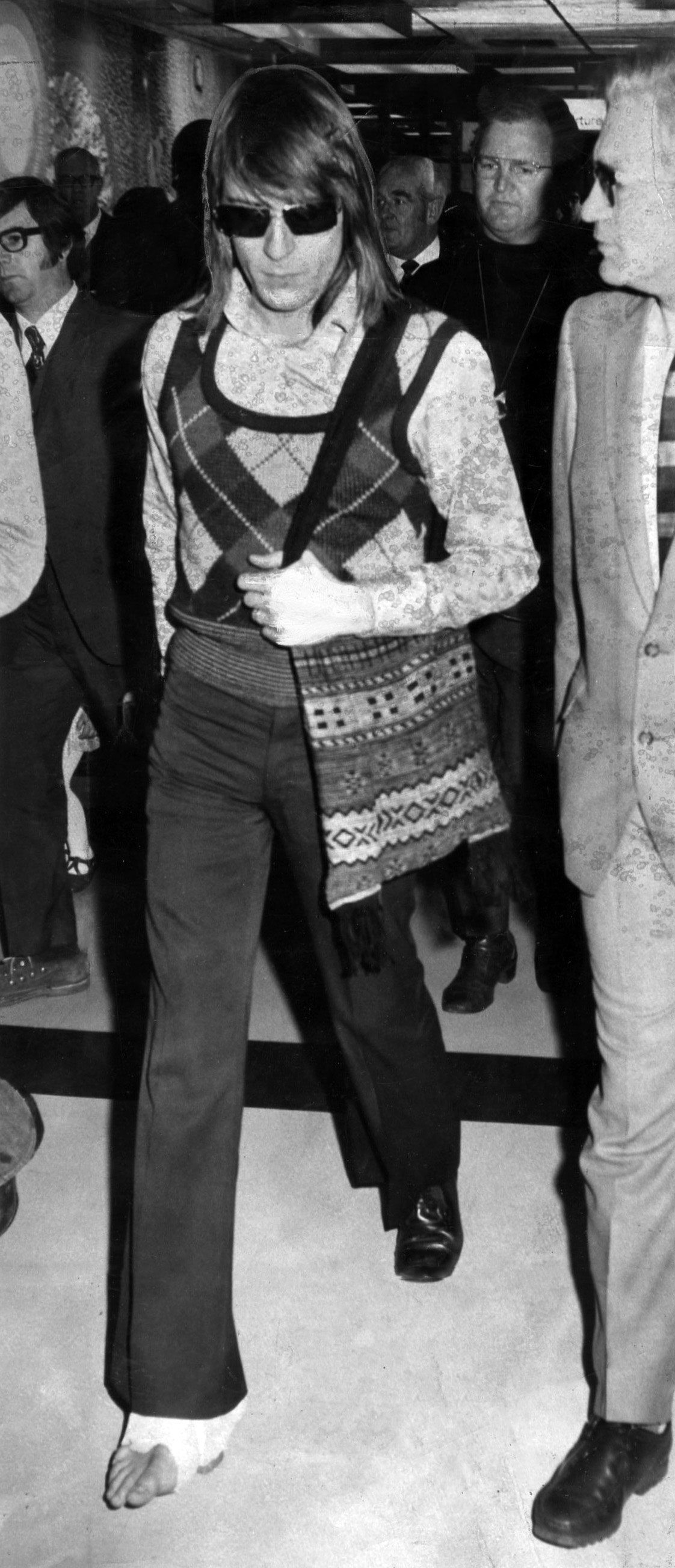
Roger James. News, 7 June 1972
Roger James. News, 7 June 1972
Dr Duncan’s body was retrieved the following morning by the Underwater Recovery Squad of SA Police. A Channel 7 television cameraman arrived late and, in an act of desecration, the body was returned to the water by police and pulled out again for filming.
An article published in Adelaide's morning broadsheet, the Advertiser, three days after the drowning, described the initial police investigation.

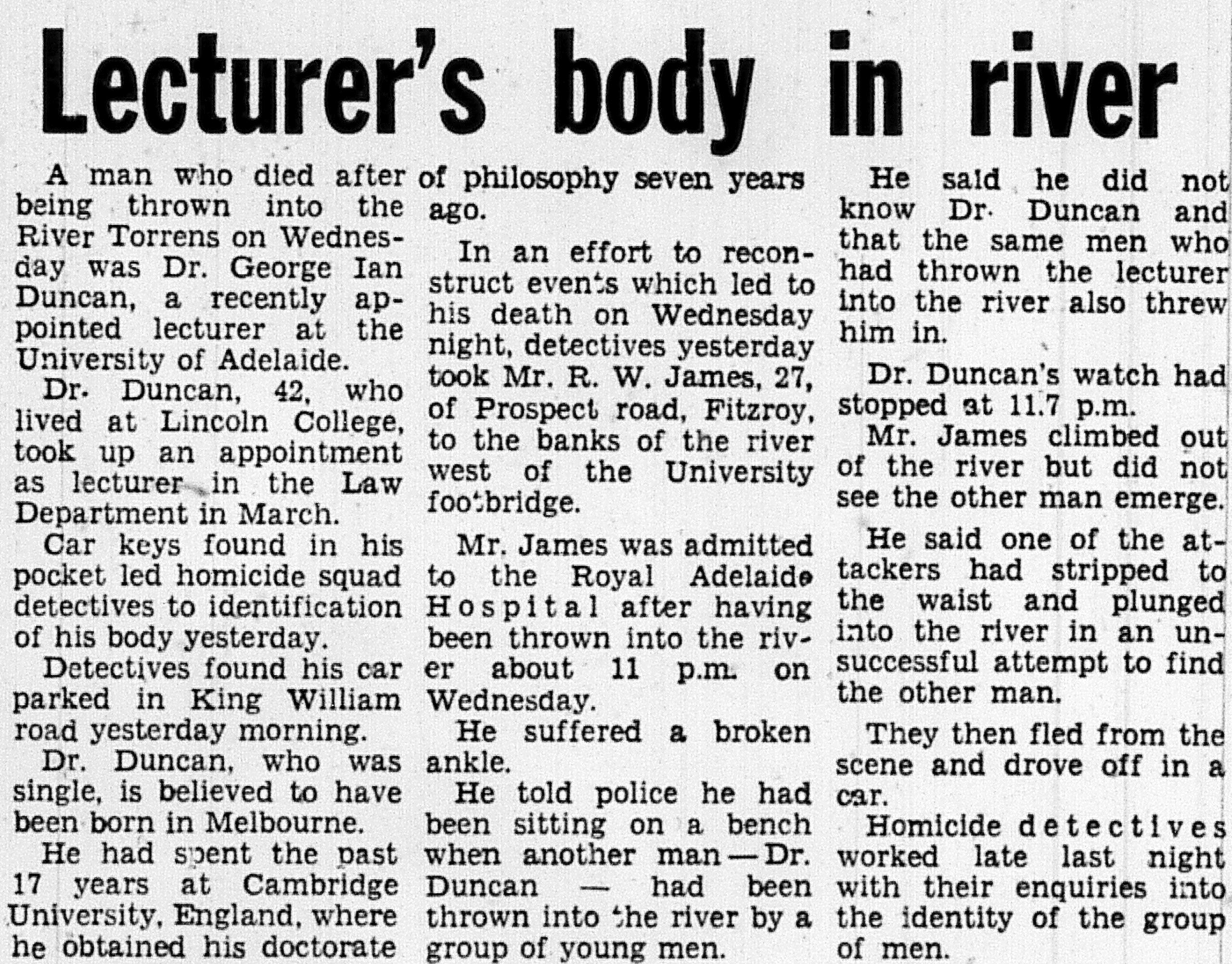
Advertiser, 13 May 1972
Advertiser, 13 May 1972
Dr Duncan was a devout Anglo-Catholic and, following a Requiem Mass, he was buried at Centennial Park Cemetery.

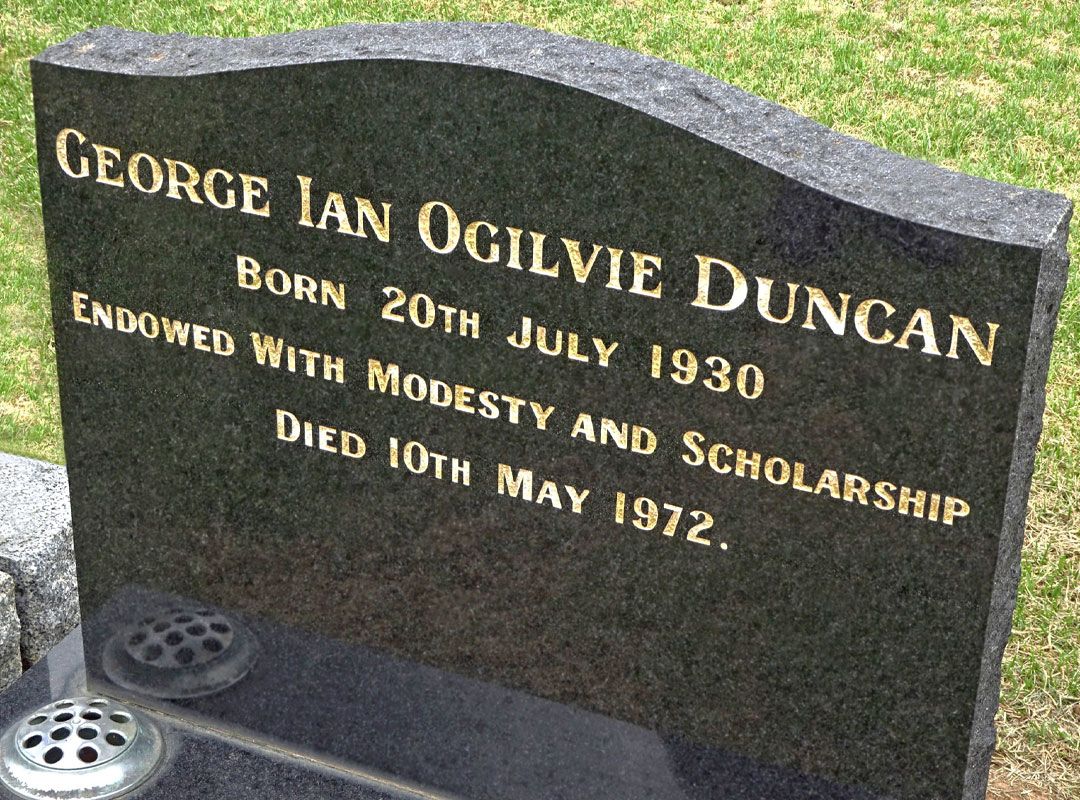
Dr Duncan's gravestone. Photographer Ian Purcell AM. SLSA: B 74154
Dr Duncan's gravestone. Photographer Ian Purcell AM. SLSA: B 74154

May - June 1972
The case deepens
Were Vice Squad officers involved in the attack?
Ten days after the drowning, it was revealed that three off-duty Vice Squad officers – who were in the vicinity that night but had not reported it - were being questioned. These men were later identified as Constables Francis Cawley and Michael Clayton, and Senior Constable Brian Hudson. All three were understood to have declined to appear in a police line-up, and at least one had refused to answer questions.
|
Constable Francis Cawley. Advertiser, 21 June 1972 Constable Francis Cawley. Advertiser, 21 June 1972 |
Constable Michael Clayton. News, 21 June 1972 Constable Michael Clayton. News, 21 June 1972 |
Senior Constable Brian Hudson. News, 21 June 1972 Senior Constable Brian Hudson. News, 21 June 1972 |

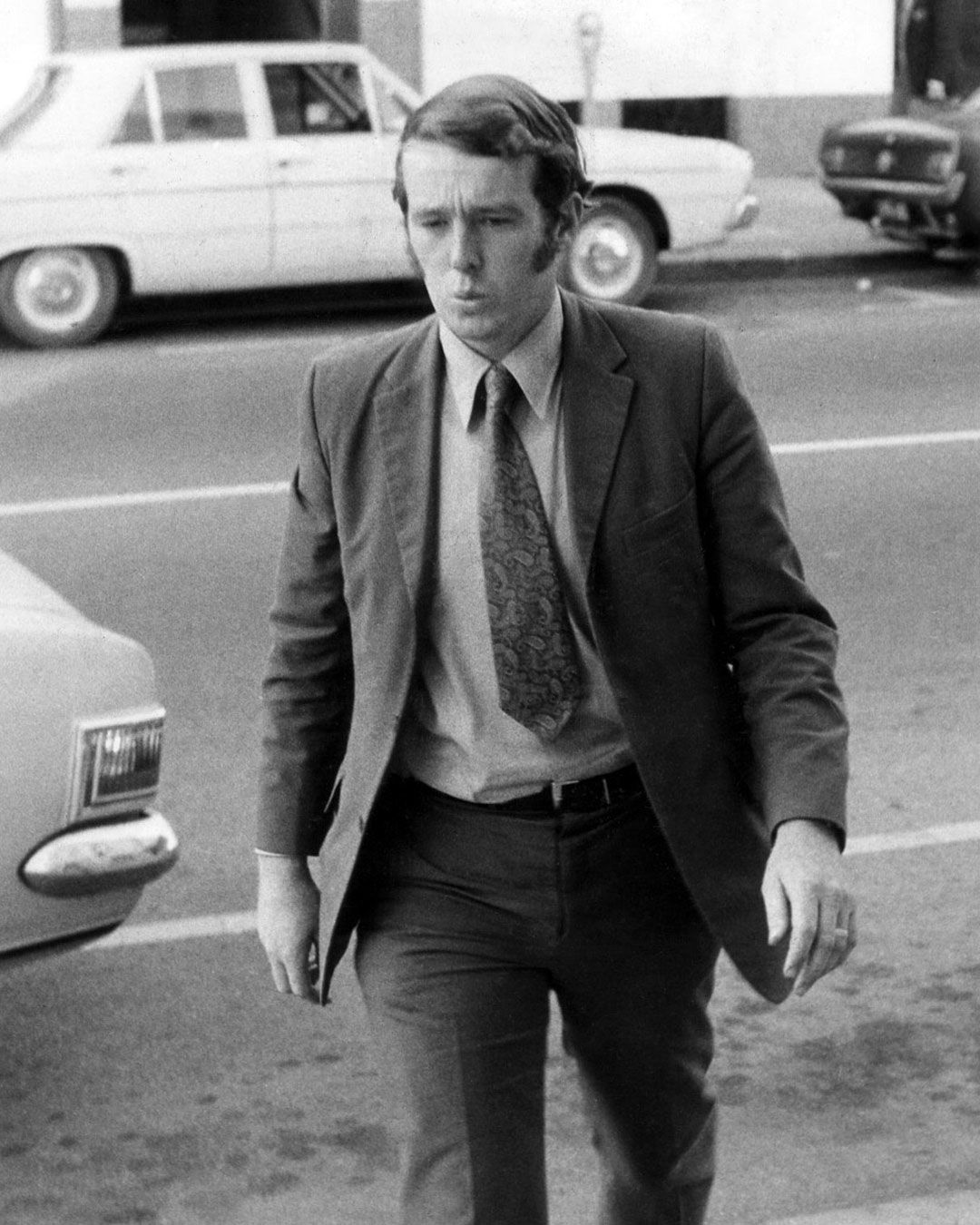
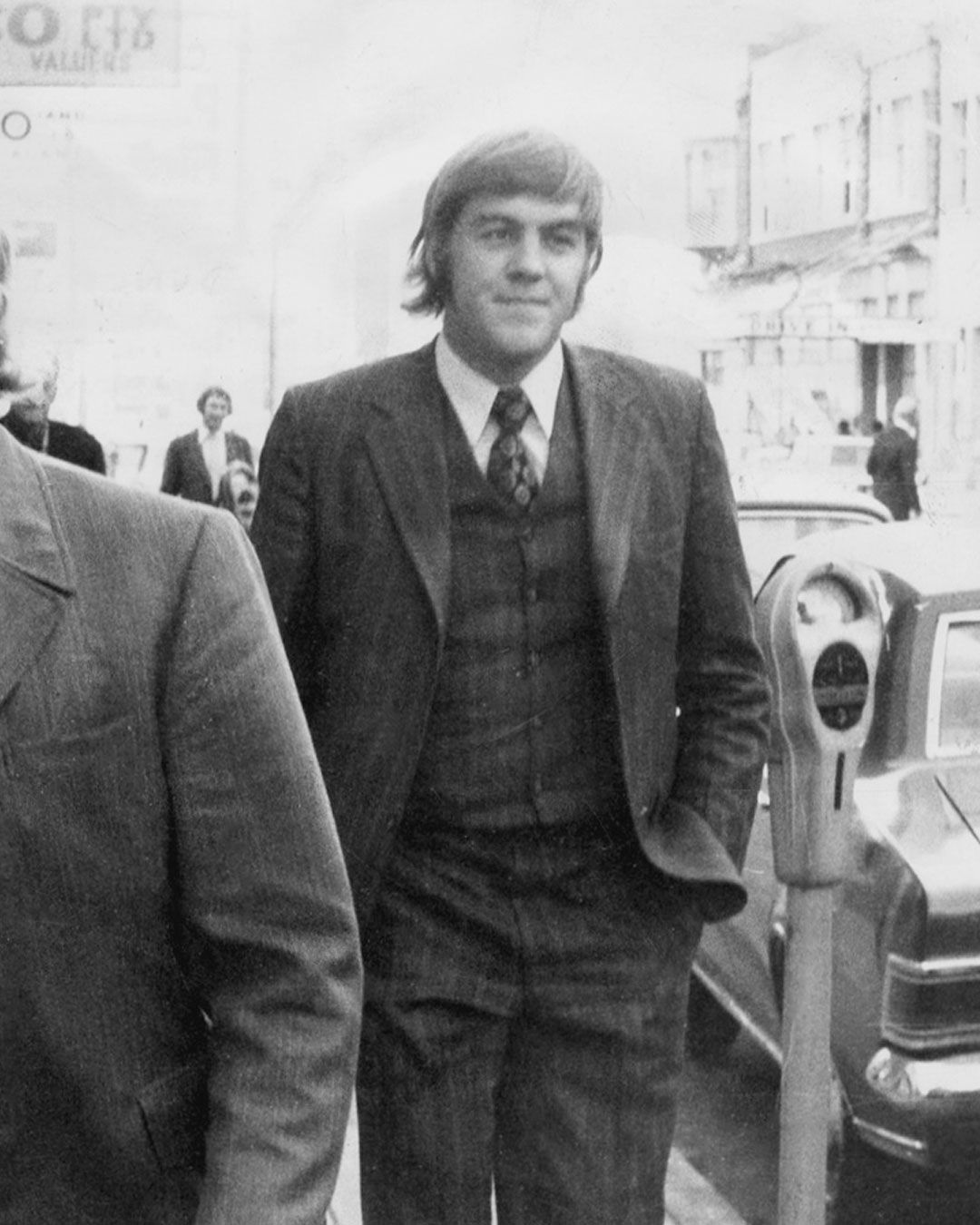
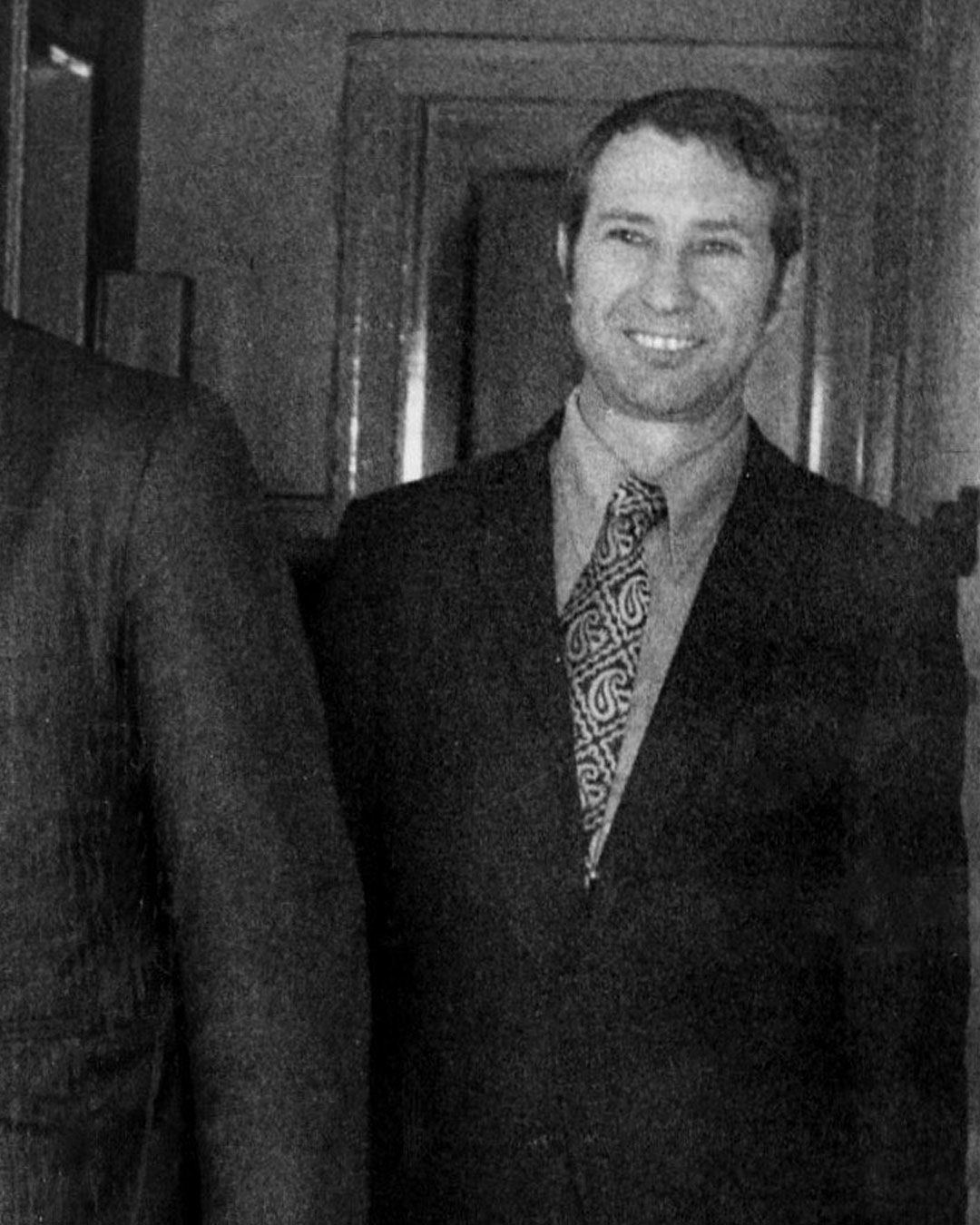
The Head of the Law Department at the University of Adelaide, and Duncan's boss, Professor Horst Lücke, responded in an explosive letter to the Police Commissioner, John McKinna. This was released to the press and followed by an Advertiser editorial.
‘In these circumstances, what steps are being taken to reassure the public of the integrity of the Police Force?’

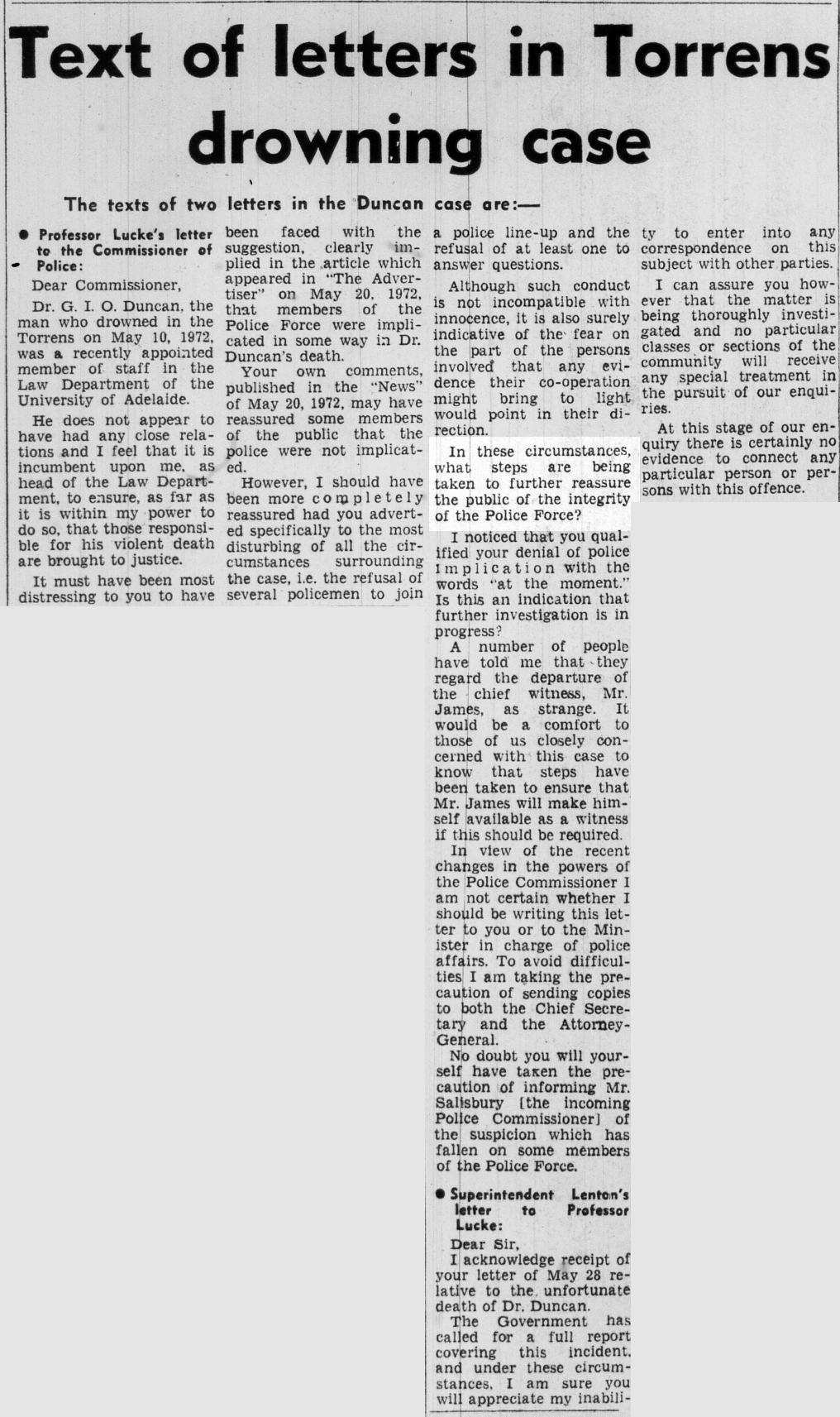
Horst Lücke’s letter and police response. Advertiser, 2 June 1972
Horst Lücke’s letter and police response. Advertiser, 2 June 1972
‘Whether justified or not, there is a feeling abroad that investigations into Dr. Duncan’s death have not been pressed with sufficient vigor.’

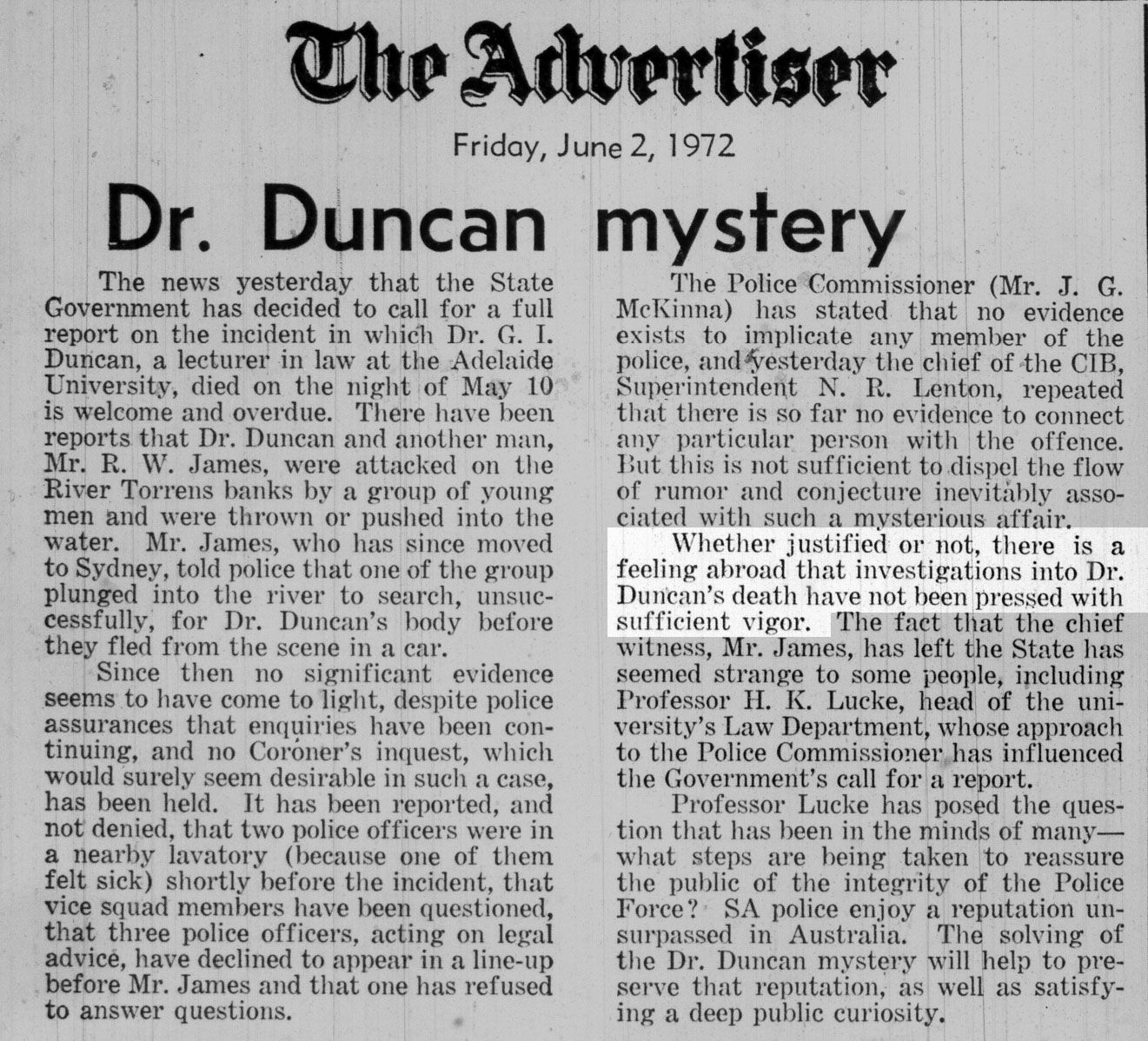
Advertiser editorial, 2 June 1972
Advertiser editorial, 2 June 1972
The Attorney-General, Len King, called for a report from SA Police, then almost immediately ordered an inquest.

June 1972
The inquest begins
It becomes one of the longest and most costly in the state's history
The inquest began on 7 June 1972 under the 78-year-old City Coroner, Tom Cleland. Running for four weeks, it took over 330 pages of evidence. The state’s Director of Forensic Pathology, Dr Colin Manock, who has since gained notoriety in relation to other cases, carried out the autopsy. He gave evidence on the opening day.
|
Tom Cleland. News, 5 July 1972 Tom Cleland. News, 5 July 1972 |
Dr Colin Manock. Advertiser, 8 June 1972 Dr Colin Manock. Advertiser, 8 June 1972 |

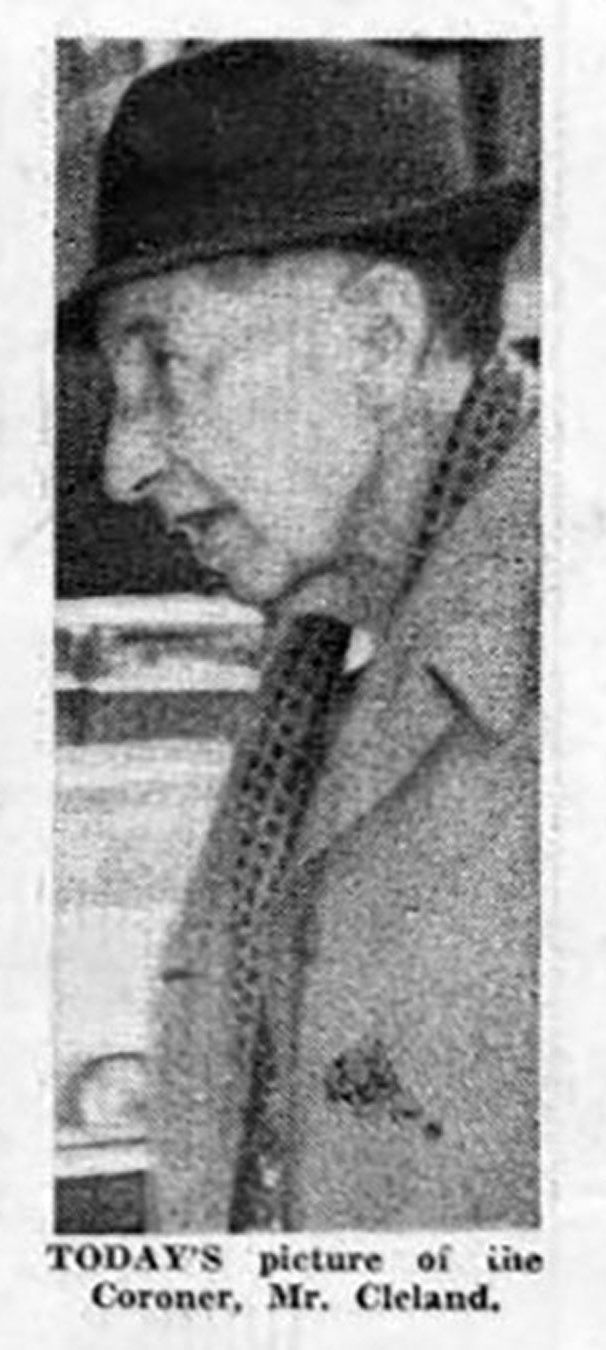

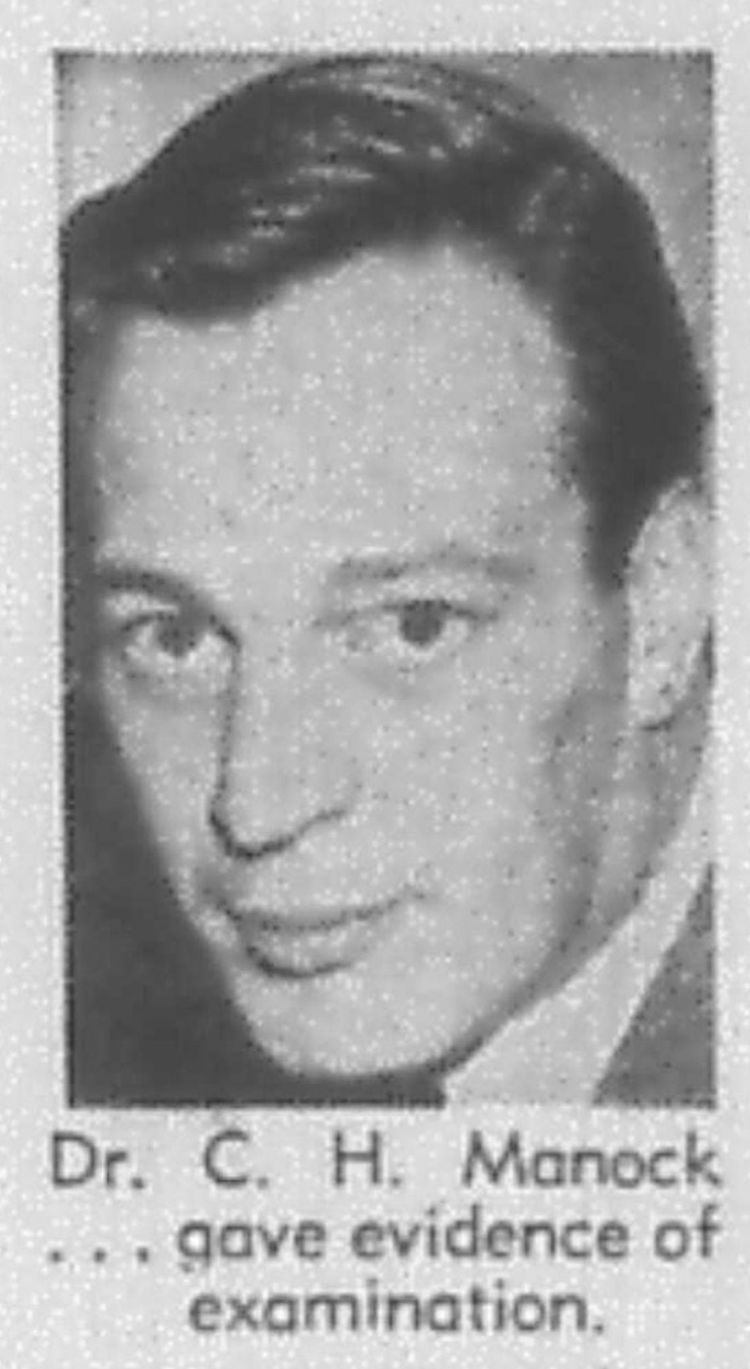
Manock determined that Duncan was a 'passive' homosexual based on a now discredited mid-19th century medical text by French doctor, Auguste-Ambroise Tardieu. A student journalist, Paul Foss, commented that it was 'chilling to realise that the law can accept the definition of homosexuality in purely pathological terms'.
Manock’s conclusion was never questioned and became the accepted wisdom about Duncan’s sexuality, with the coroner’s final report stating that ‘Dr. Duncan was a homosexual’.

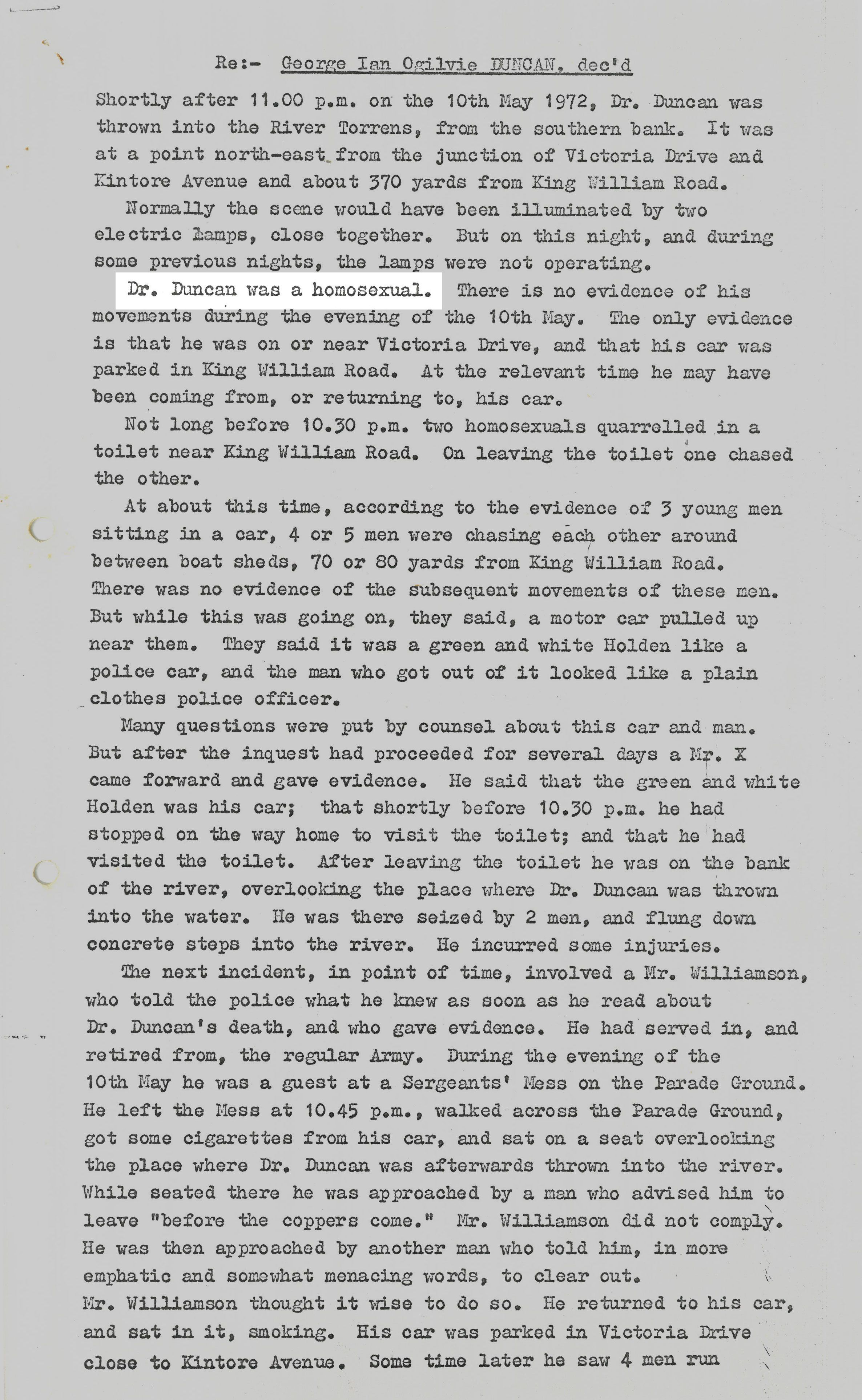
Inquest statement, Dr Duncan’s homosexuality. SLSA: D 8754(L)/22
Inquest statement, Dr Duncan’s homosexuality. SLSA: D 8754(L)/22

WHERE THE DOCTOR DIED
An Advertiser front-page story of 21 June 1972 featured an aerial photograph taken by Pat Crowe.
This photo showed key sites on the Torrens riverbank connected with the Duncan case.
1. Where witness James sat on the night of the drowning
2. Area where Dr Duncan and James allegedly were pushed into the river
3. James found here after crawling from river bank with broken ankle
4. Witness Mr K W Williamson's car parked here
5. Torrens Parade Ground and drill hall where Williamson was drinking on night of May 10
6. Torrens Lake police station
7. Gum tree under which two mystery men were seen standing
8. Women's lavatory
9. Men's lavatory
10. Jolley's Lane
16. Area where secret witnesses parked in cars
11. Jolley's boat shed
12. Torrens Rowing Club boat shed
13. Adelaide Boys High School boat shed
14. Boat building shed
15. Adelaide Bridge steps
June 1972
The inquest continues
Anonymous witnesses are encouraged to come forward
The Premier, Don Dunstan, promised government protection, including anonymity, to four witnesses who gave evidence. One claimed that earlier that night he had twice been thrown down concrete steps before also being tossed into the river. Like Roger James, he was unable to identify his assailants.

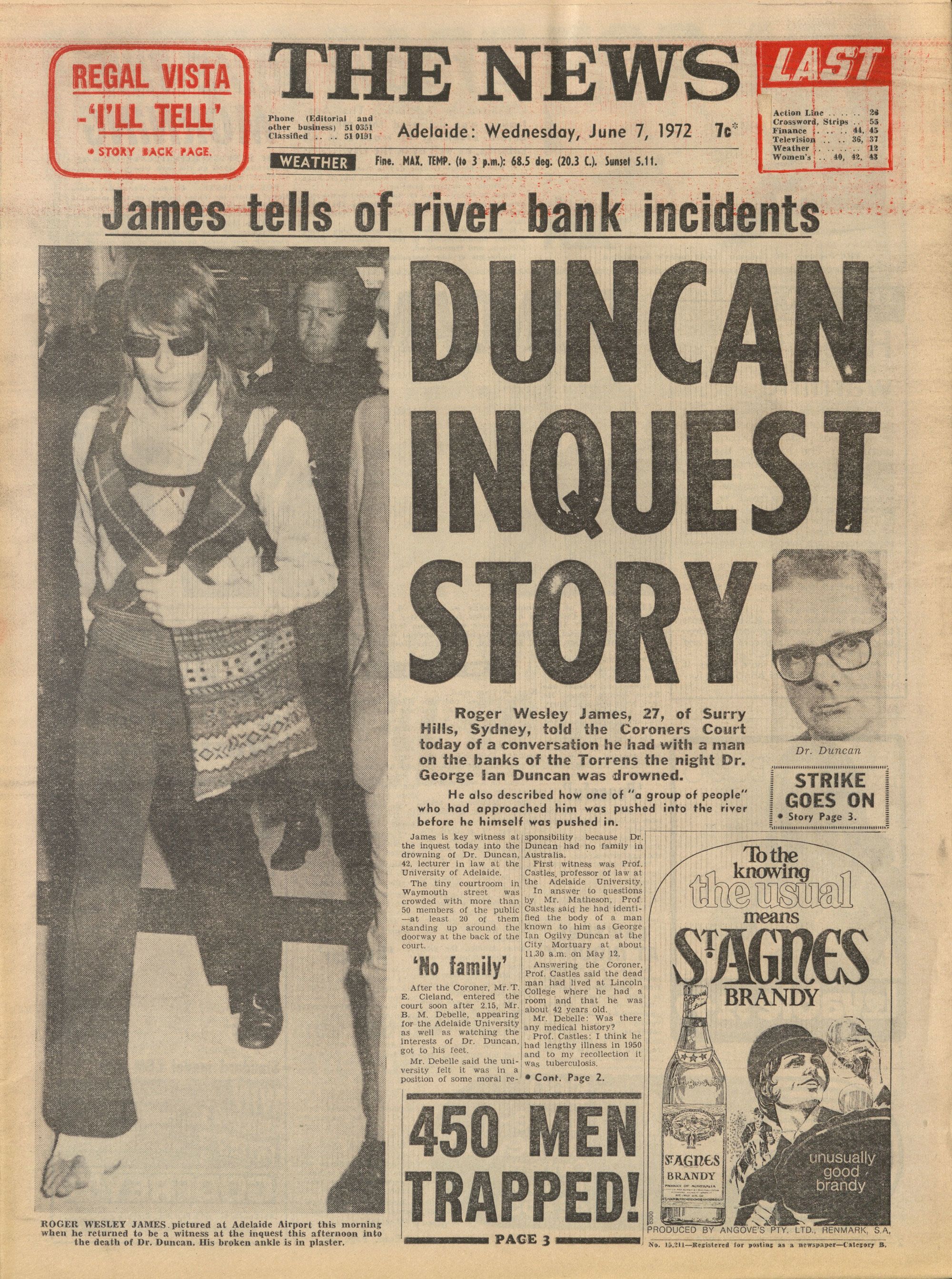
News, 7 June 1972
News, 7 June 1972
Another witness, Kevin Williamson, stated he had been sitting on a seat where he could have seen the killing, before being warned off by two men. He could not recognise them, he said, but changed his evidence to the later New Scotland Yard inquiry. The men in question, he said, were Hudson and Clayton. The inquest also revealed allegations that Cawley was seen that night by three uniformed constables who were on duty in the area.
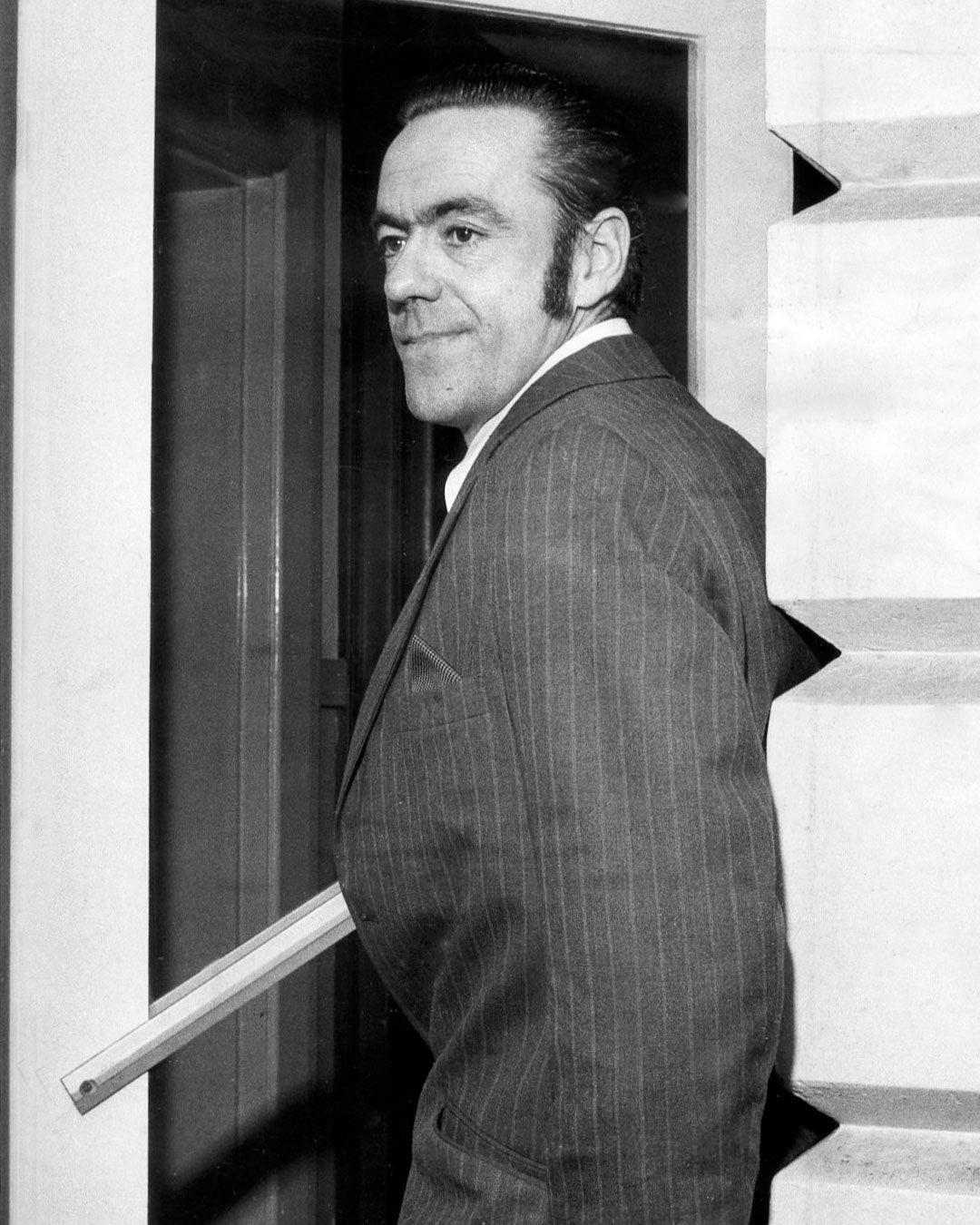
Kevin Williamson. Advertiser, 17 June 1972
Kevin Williamson. Advertiser, 17 June 1972
From 29 to 30 June, Cawley, Clayton and Hudson took the stand. They declined to answer questions on the grounds that they might tend to incriminate themselves. Informed by their superior that their refusal ‘reflected discredit on the police force’, they were suspended from official duties.
Within two weeks, all three had resigned.

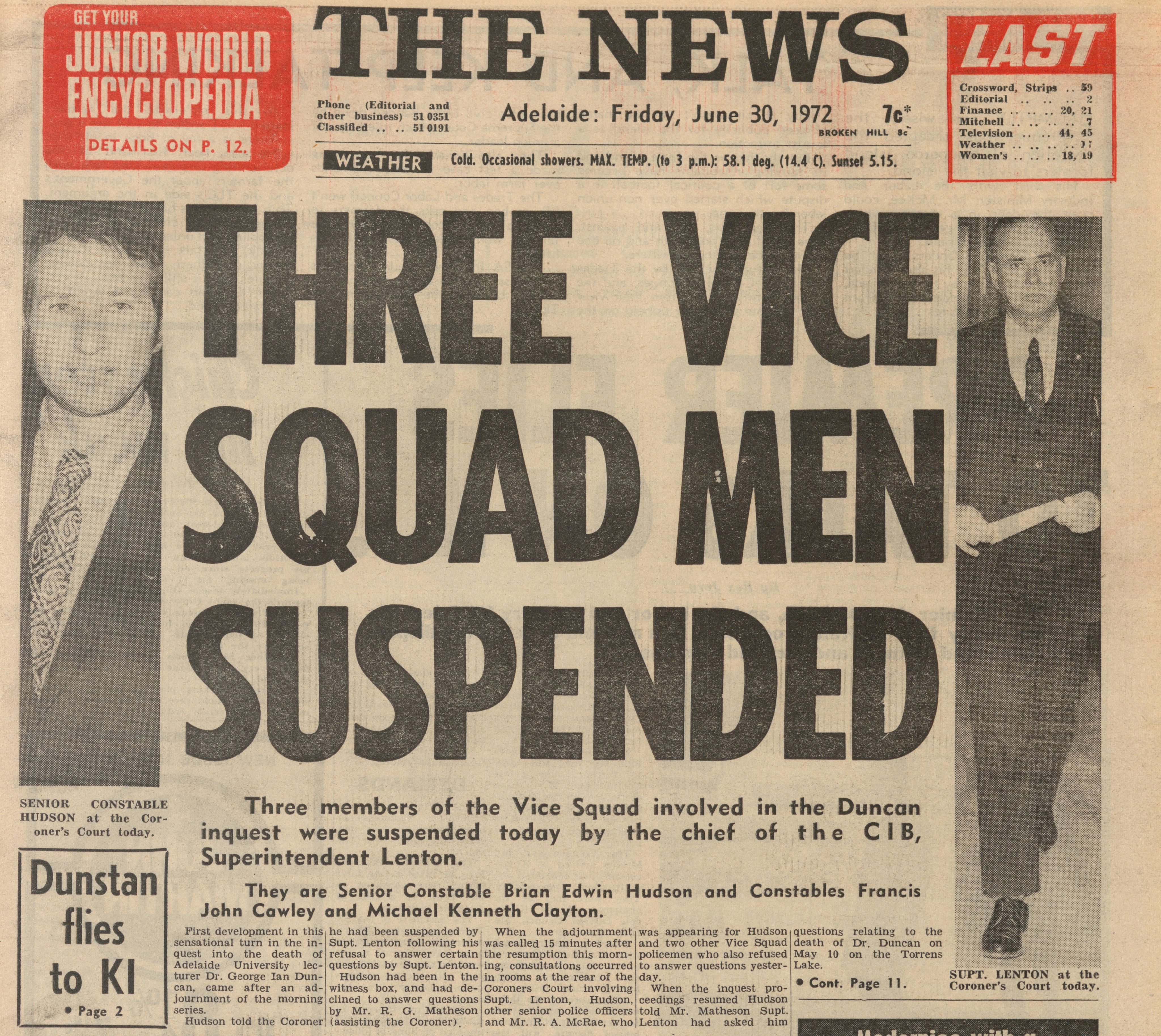
News, 30 June 1972
News, 30 June 1972

July 1972
The inquest concludes
The Coroner delivers an open finding

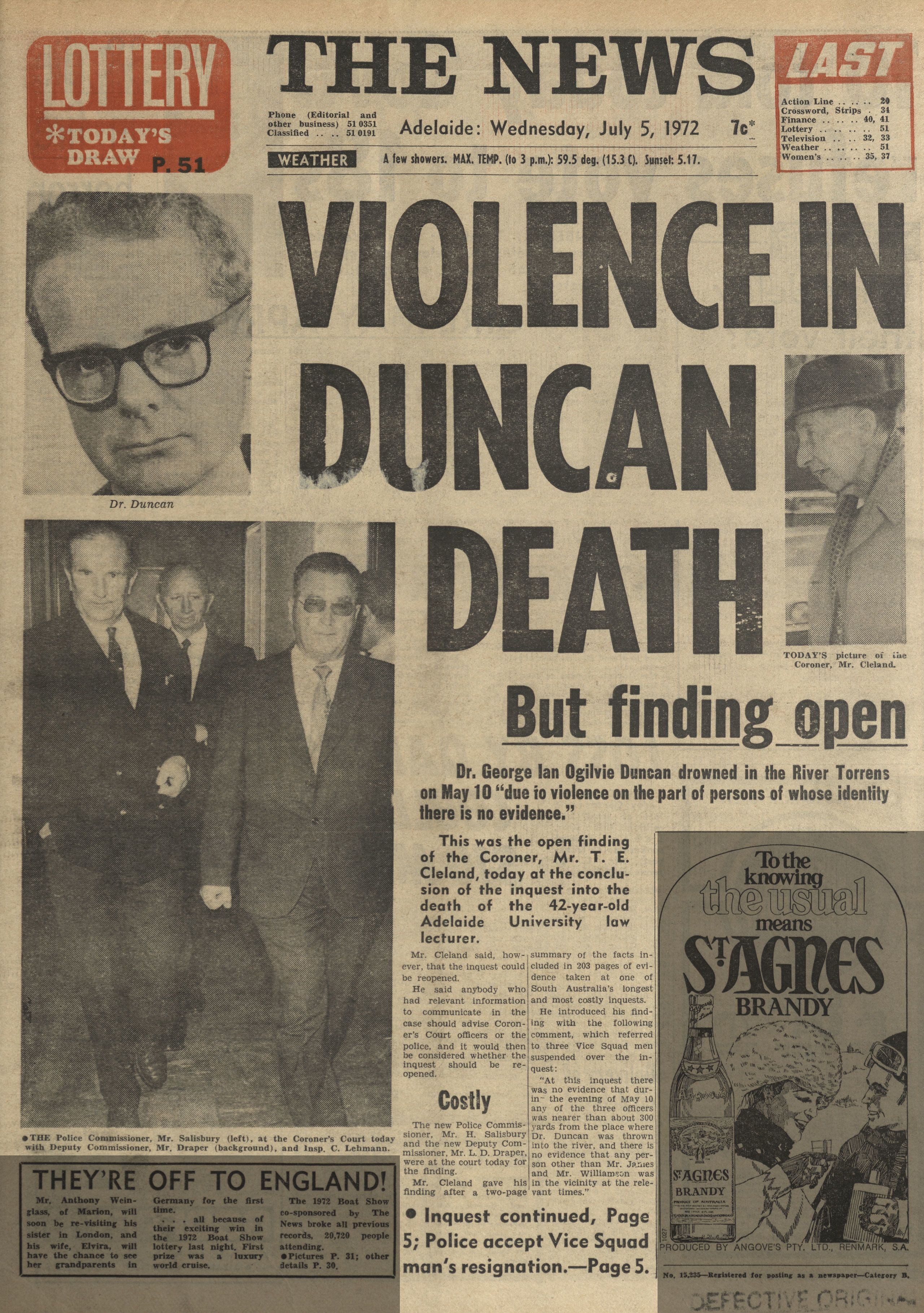
News, 5 July 1972
News, 5 July 1972
Tom Cleland released his report on 5 July. He found that:
‘At this inquest there was no evidence that during the evening of the 10th May any of the three officers [Cawley, Clayton and Hudson] was nearer than about 300 yards [275 metres] from the place where Dr. DUNCAN was thrown into the river’
And he concluded:
‘The cause of his death was drowning due to violence on the part of persons of whose identity there is no evidence.'

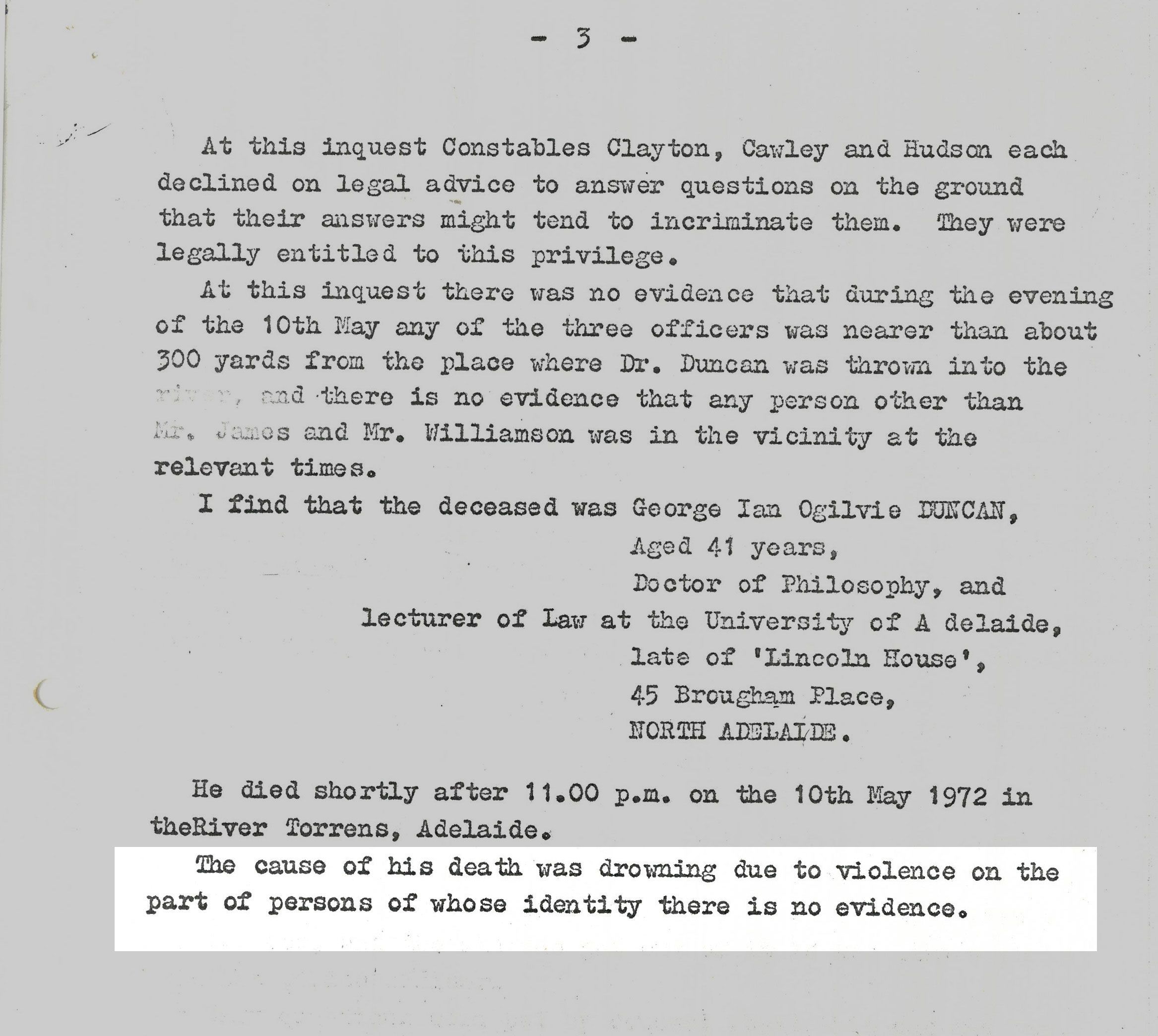
Inquest report, conclusion. SLSA: D 8754(L)/22
Inquest report, conclusion. SLSA: D 8754(L)/22
With such intense media interest in the case, the ABC ran a major story for its current affairs program, This Day Tonight. The ABC later incorporated Channel 7 footage of the body being retrieved.


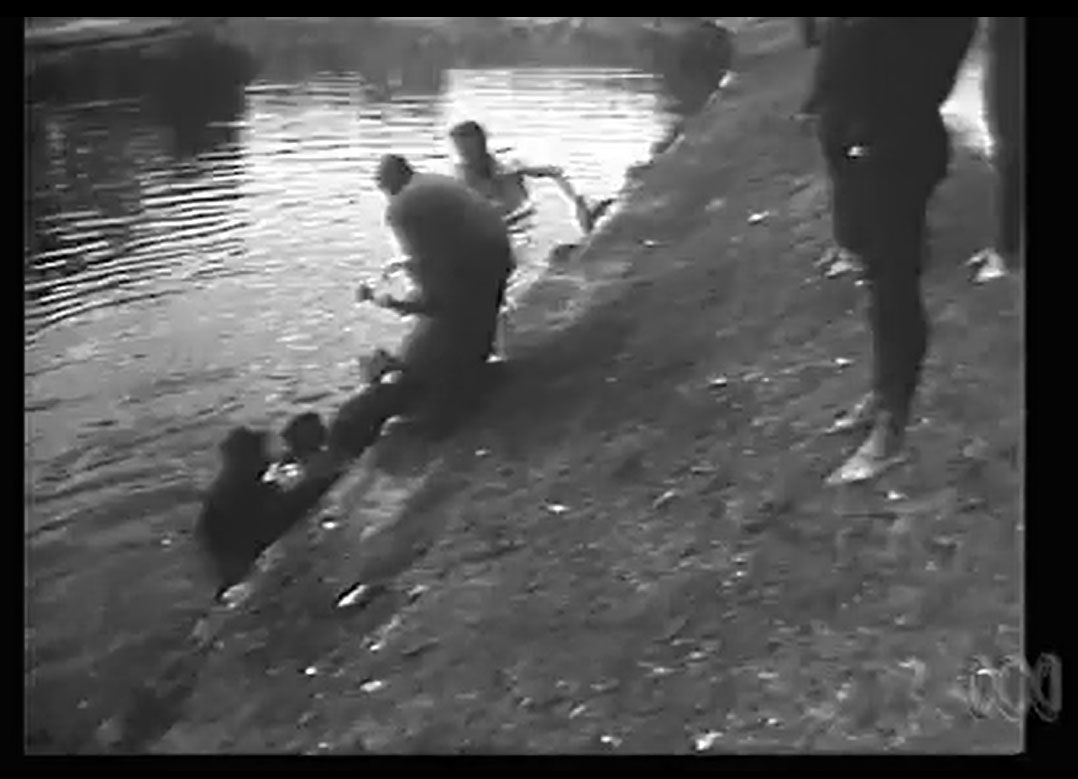
Dr Duncan's body being pulled out of the River Torrens. Screen capture, This Day Tonight, ABC, 19 July 1972
Dr Duncan's body being pulled out of the River Torrens. Screen capture, This Day Tonight, ABC, 19 July 1972

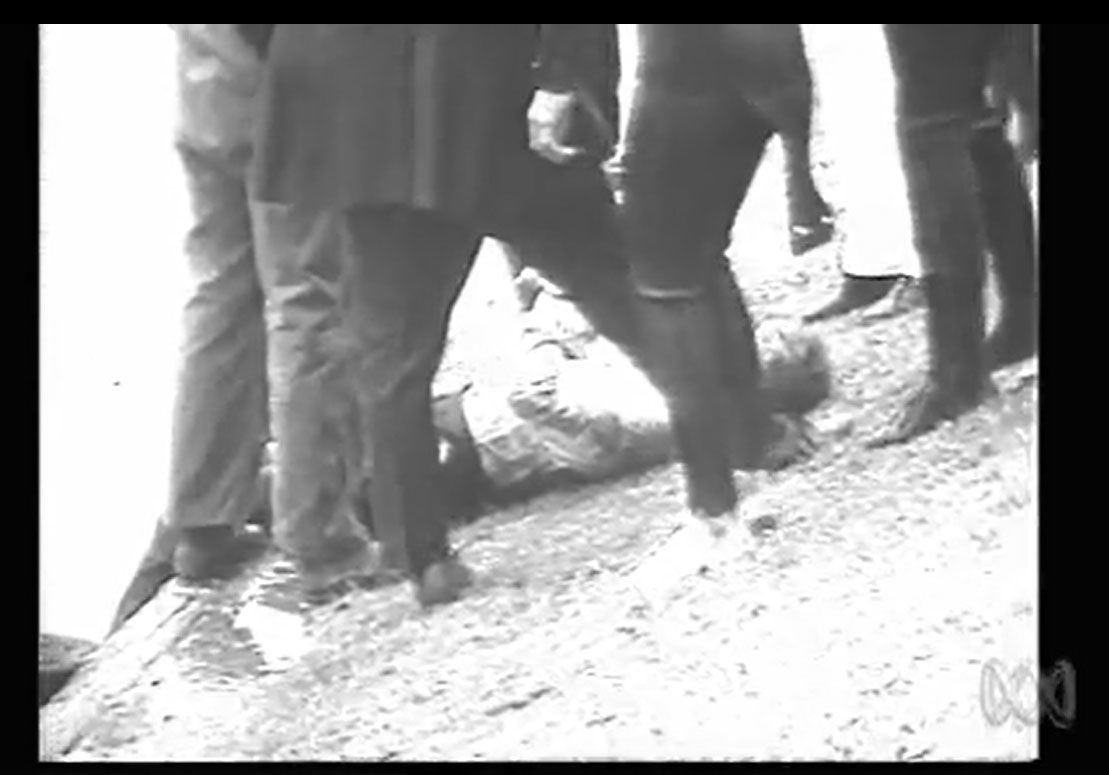
Dr Duncan's body lying on the Torrens riverbank. Screen capture, This Day Tonight, ABC, 19 July 1972
Dr Duncan's body lying on the Torrens riverbank. Screen capture, This Day Tonight, ABC, 19 July 1972

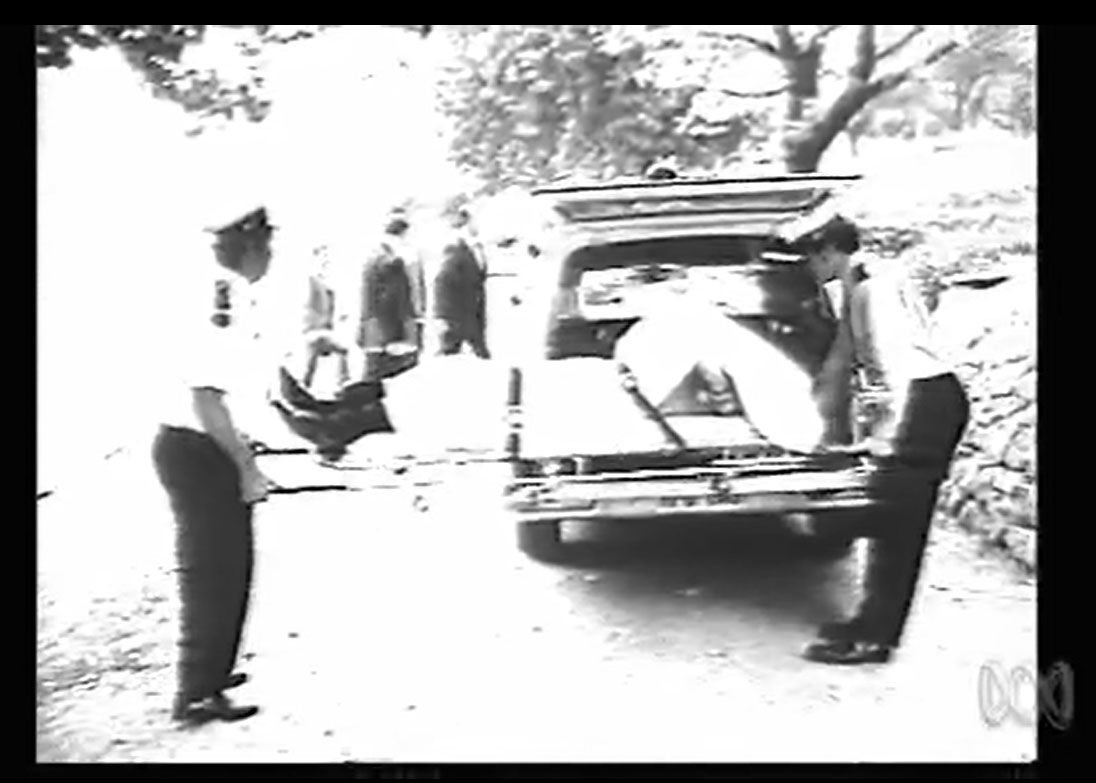
Dr Duncan's body being placed in an ambulance. Screen capture, This Day Tonight, ABC, 19 July 1972
Dr Duncan's body being placed in an ambulance. Screen capture, This Day Tonight, ABC, 19 July 1972


August 1972
New Scotland Yard is called in
The Premier acts over growing public unease
Don Dunstan called in his new (British) Police Commissioner, Harold Salisbury, and expressed his government’s disquiet over the Duncan affair. He accepted Salisbury’s recommendation to seek the services of London’s New Scotland Yard, which agreed to send two detectives.
Detective Chief Superintendent Bob McGowan and Detective Sergeant Charles O’Hanlon arrived in Adelaide on 6 August 1972.

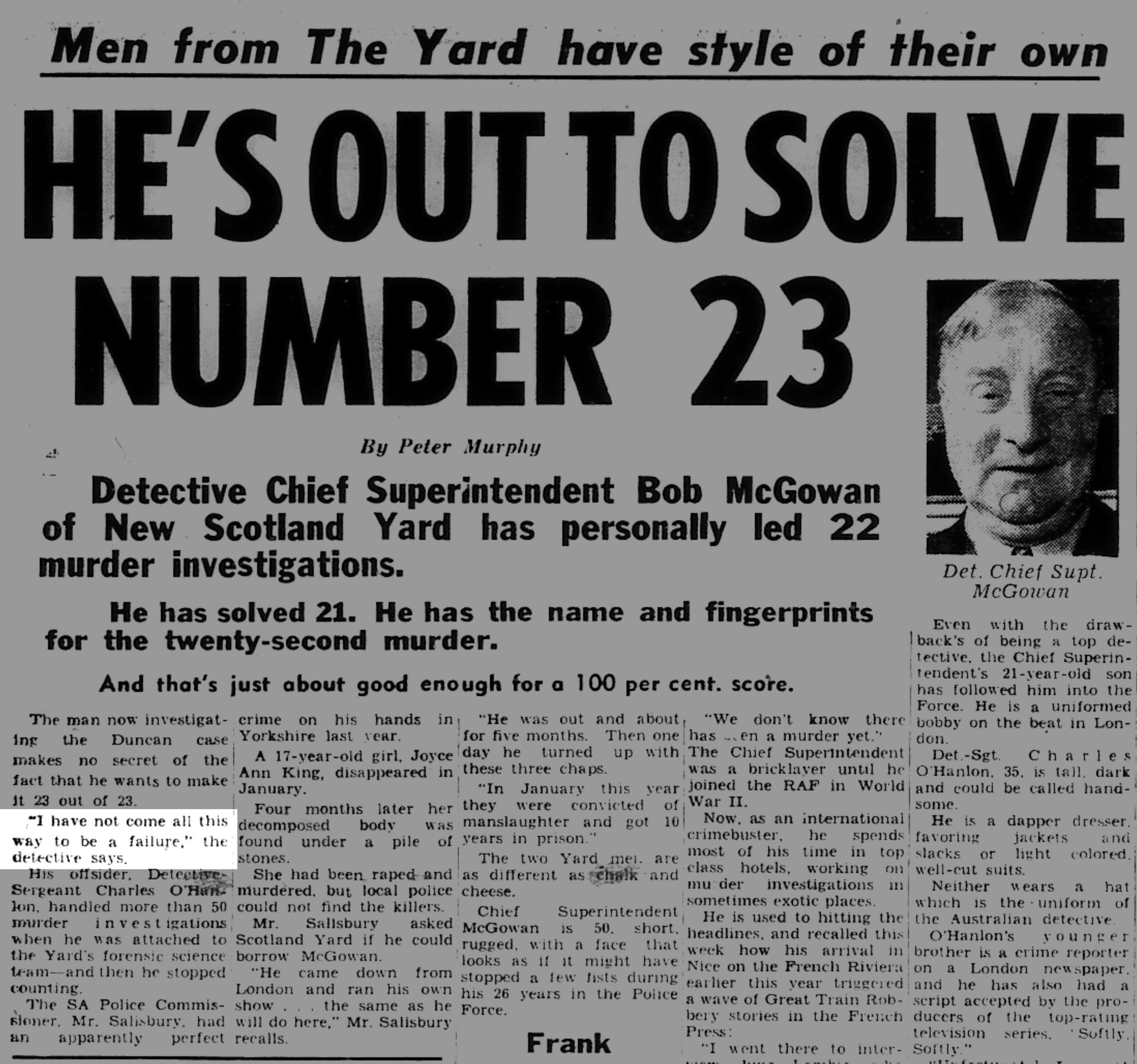
Sunday Mail, 12 August 1972
Sunday Mail, 12 August 1972
‘I have not come all this way to be a failure’
These were words that McGowan would later rue. He refuted suggestions that his job was to investigate SA Police and refused to describe Dr Duncan’s death as a murder. He would head a nine-man team at SA Police headquarters.
Within three weeks, a call was made for public assistance. Dr Duncan had been seen dining with different men aged about 30, suggesting he had quickly become active on the dating scene. The local gay and lesbian group CAMP was consulted, but its members had never met him. There was no reference to this aspect of Dr Duncan’s life in the final New Scotland Yard report.
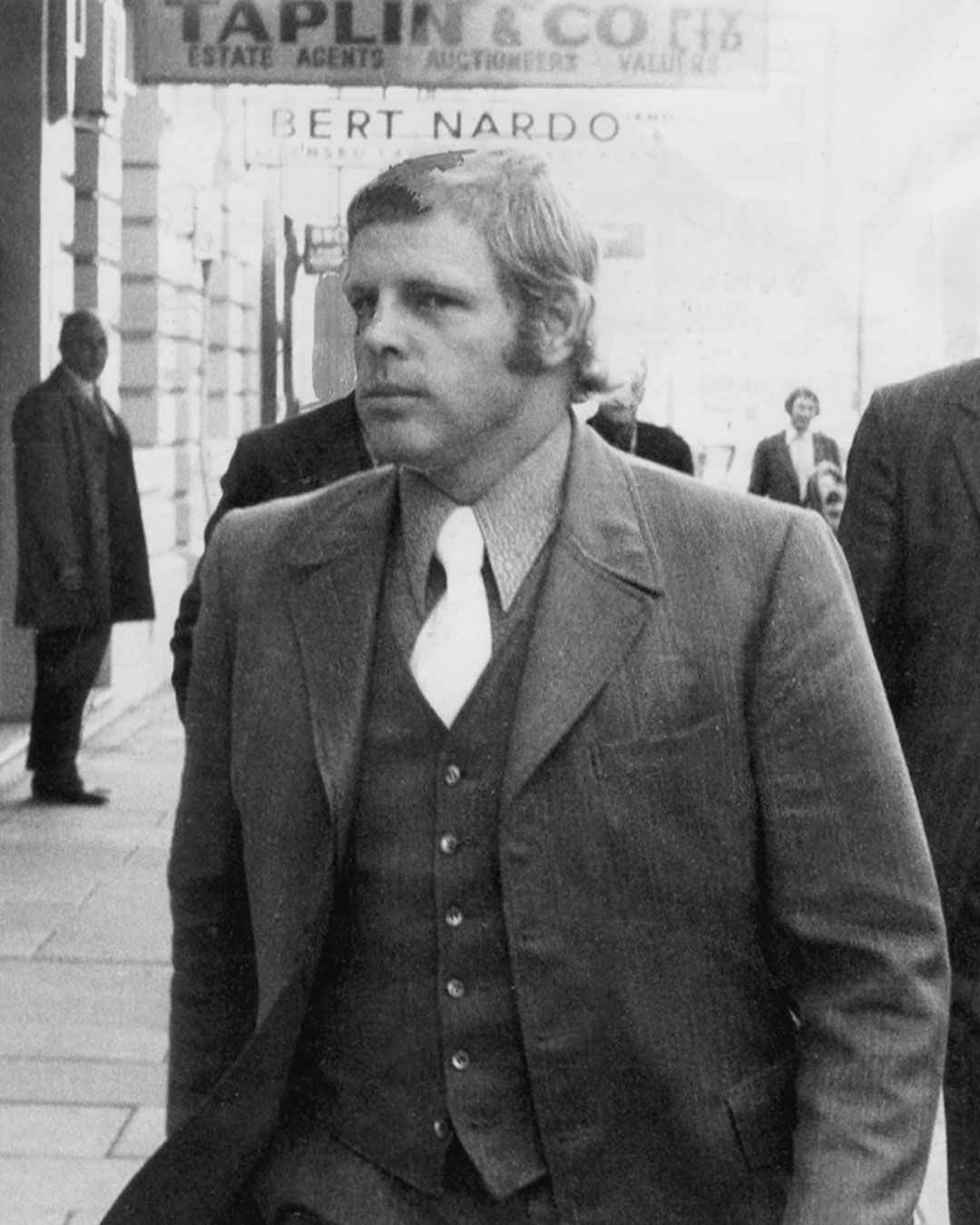
Constable Mick O'Shea. News, 21 June 1972
Constable Mick O'Shea. News, 21 June 1972
Mick O’Shea, a constable who early on was mistakenly regarded as the mystery ‘fourth man’ in the Duncan case, said one of the Yard detectives had told him that there was nothing you could do ‘when policemen closed ranks’. But O’Shea added derisively: ‘The consensus among the blokes in the force was that they were just a couple of old warbs from London.’

October 1972
The Yard submits its report
There is insufficient evidence for a prosecution
Over nearly two months, the New Scotland Yard inquiry would interview 395 people, including those involved in the original police investigation and inquest. The final report was penned by McGowan.
At a press conference of 24 October 1972, Commissioner Salisbury was joined by Deputy Commissioner, Laurence Draper, together with McGowan and O’Hanlon. All were stony-faced. Salisbury read from a statement and refused to answer questions:
‘As was said at the time when the Government was asked to call in the New Scotland Yard detectives, an entirely independent investigation by an outside force was the only way in which the Duncan case could be satisfactorily brought to a conclusion. The investigation has been carried out meticulously, in the greatest possible detail, and on the evidence submitted to the Crown Solicitor the decision has been made that there are inadequate grounds for a prosecution’

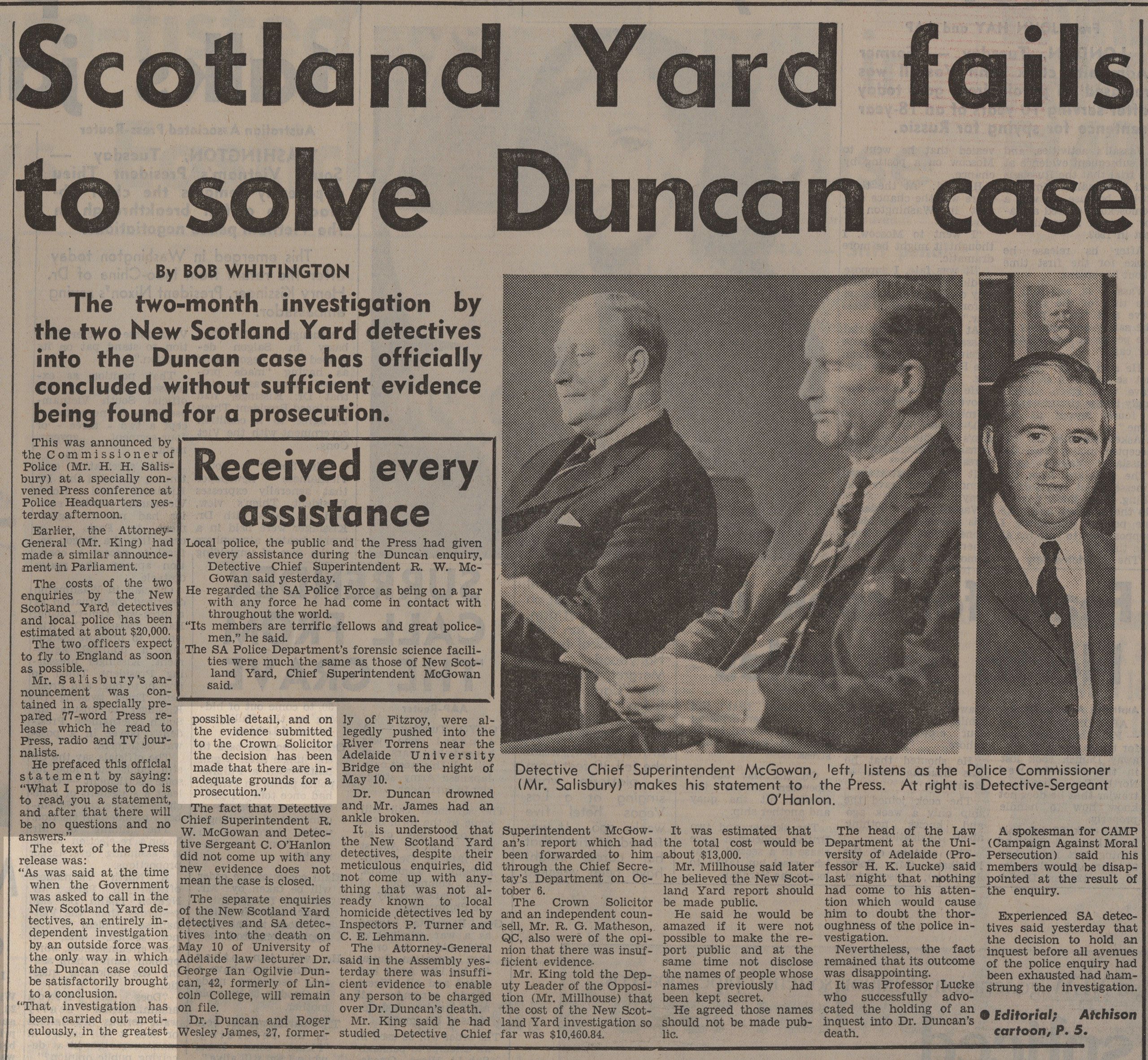
Advertiser, 25 October 1972
Advertiser, 25 October 1972
October 1972
Fallout from the inquiry
The report had recommended manslaughter charges
The Premier, Don Dunstan, tried to make the best of bad news by saying:
'I think the result shows that the SA Police Force did make a meticulous investigation'
But for a case that had attracted so much public attention and concern, Commissioner Salisbury’s refusal to answer press questions was self-defeating. He was later sacked by Dunstan for withholding information that police had maintained secret files on South Australian citizens.

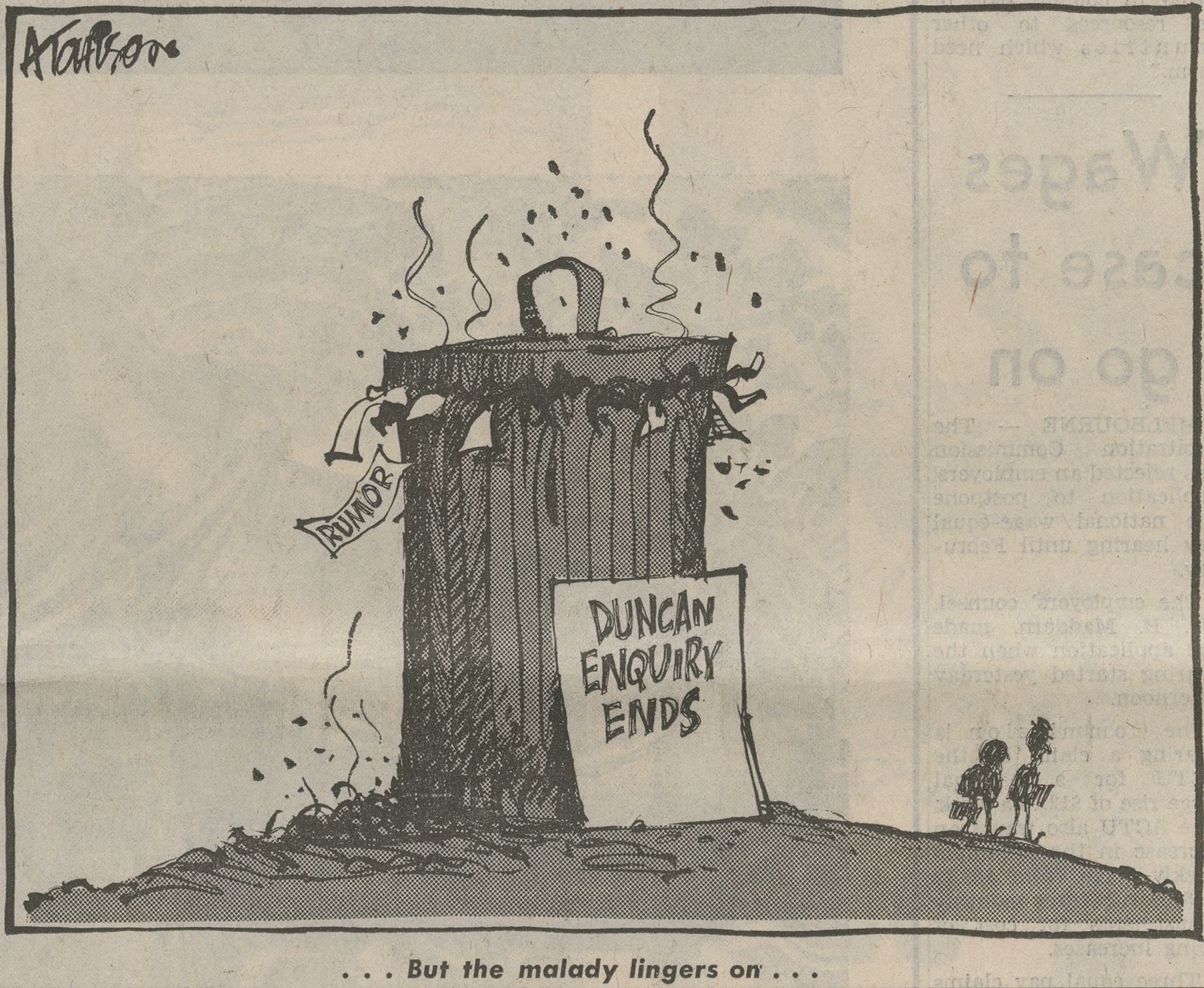
Atchison cartoon. Advertiser, 25 October 1972
Atchison cartoon. Advertiser, 25 October 1972
It was leaked to the press that the Yard detectives had recommended manslaughter charges be laid against three men. Calls immediately sprang up for the report to be made public, but this would take another 30 years. During this time, false rumours spread that people high up in Adelaide society had been named, including judges, senior policemen and politicians.

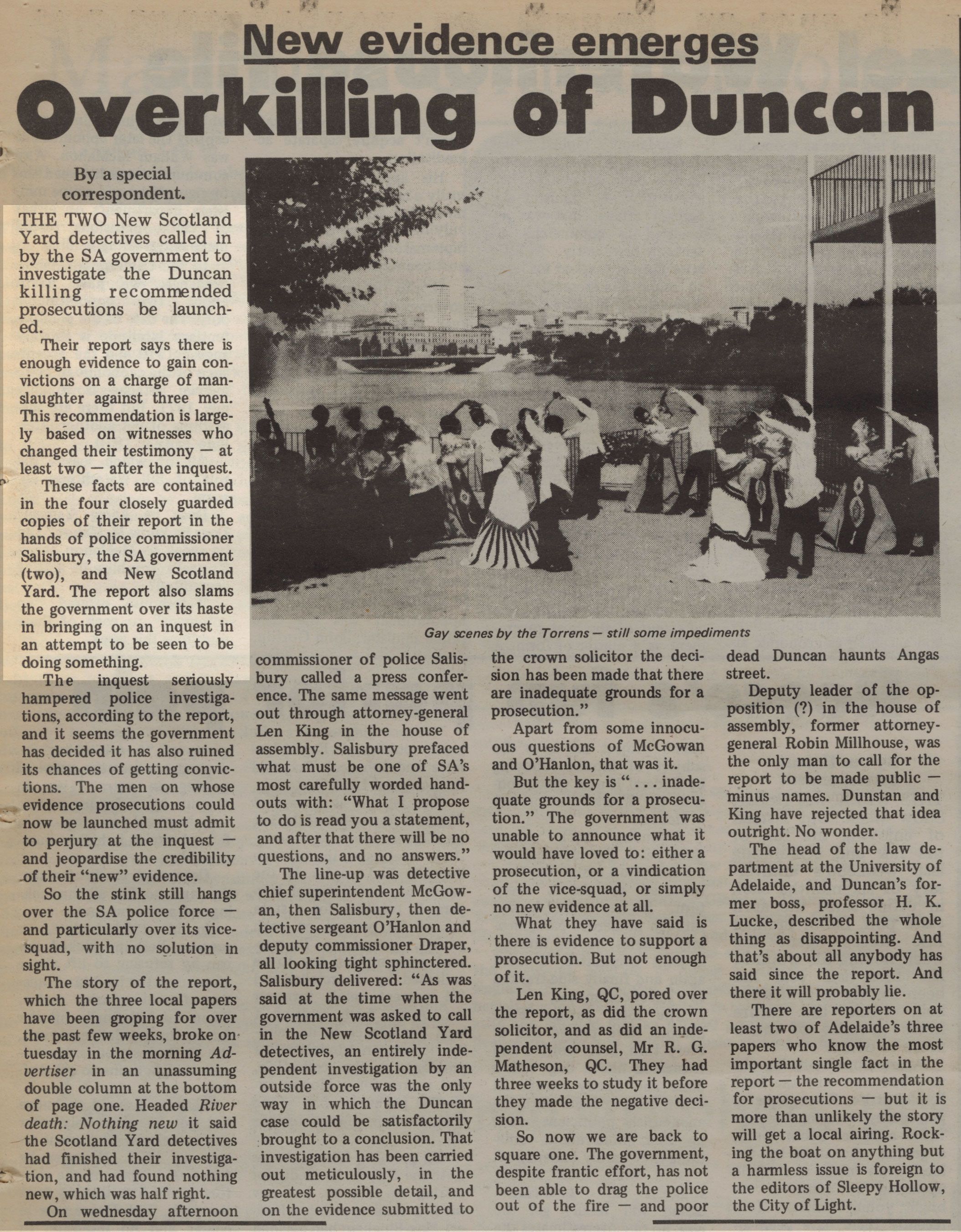
Nation Review, 28 October-3 November 1972
Nation Review, 28 October-3 November 1972
McGowan and O’Hanlon returned to Britain. McGowan was later sentenced to three years jail for evading value-added tax. O’Hanlon was sentenced to seven years for his role in a pornography protection racket. It was hardly a ringing endorsement of them or New Scotland Yard.
But there was now a wider issue at play. Dr Duncan's death became the catalyst for South Australia's first attempt at gay law reform.


 Built with Shorthand