
Leading the Nation
Reform attempts


May - July 1972
Dr Duncan’s death triggers debate
The South Australian community is forced to confront its attitudes towards homosexuality
The killing of Dr Duncan, a respected academic, possibly by off-duty Vice Squad officers, shocked the community. It provoked a debate about gay law reform.
Two weeks after the inquest had commenced, an open letter was sent to South Australian parliamentarians from a group styling itself the ‘Moral Freedom Committee’. This was mainly comprised of members of the Humanist Society of South Australia.
‘The question of homosexual behaviour is a moral matter and therefore not the law’s business. The law does not punish fornication and adultery; it should not punish homosexual behaviour’

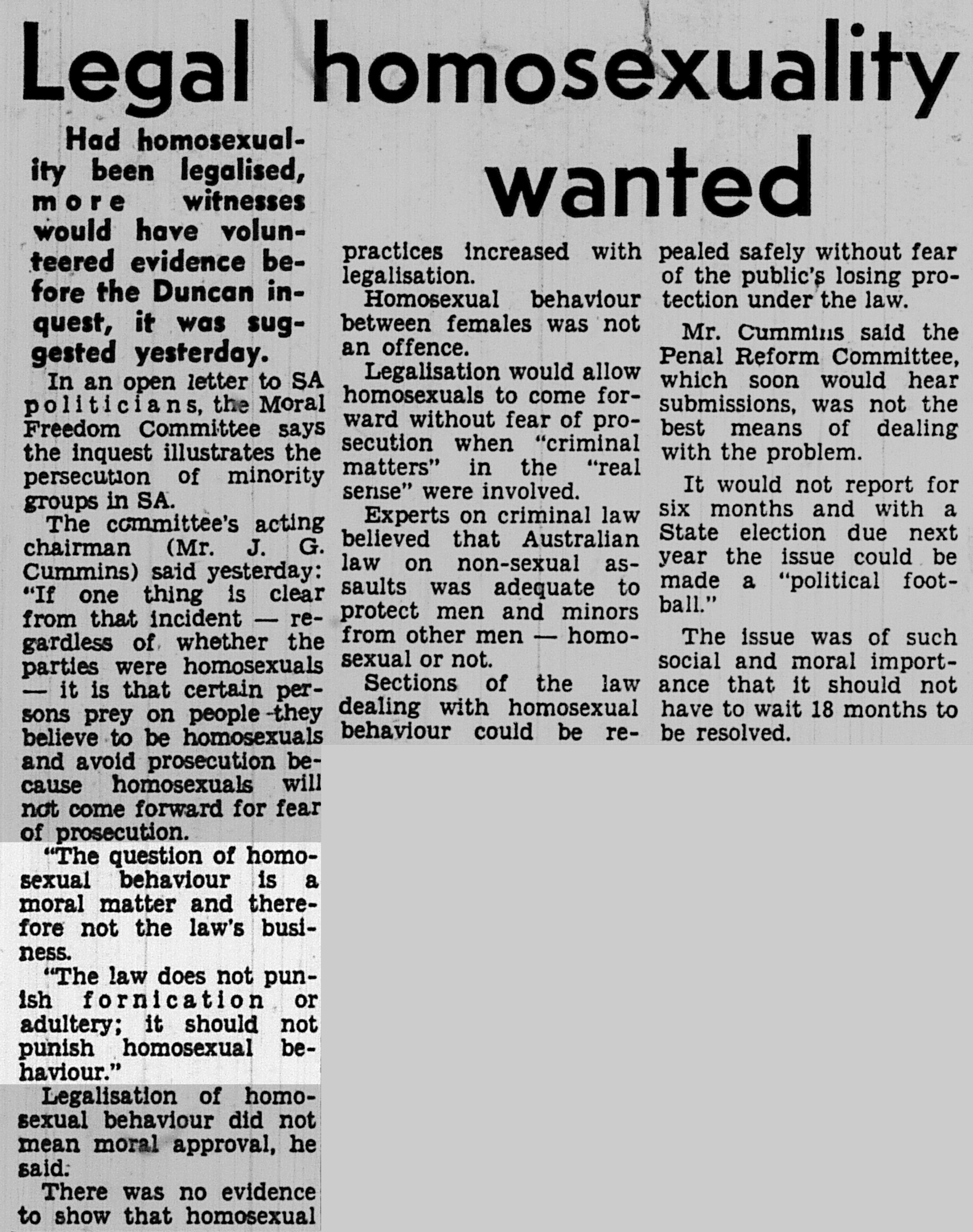
Advertiser, 23 June 1972
Advertiser, 23 June 1972
The Advertiser followed this with a stirring editorial, asserting that:
‘The State has no business in its citizens’ bedrooms and the sooner it is completely removed from them, the better'

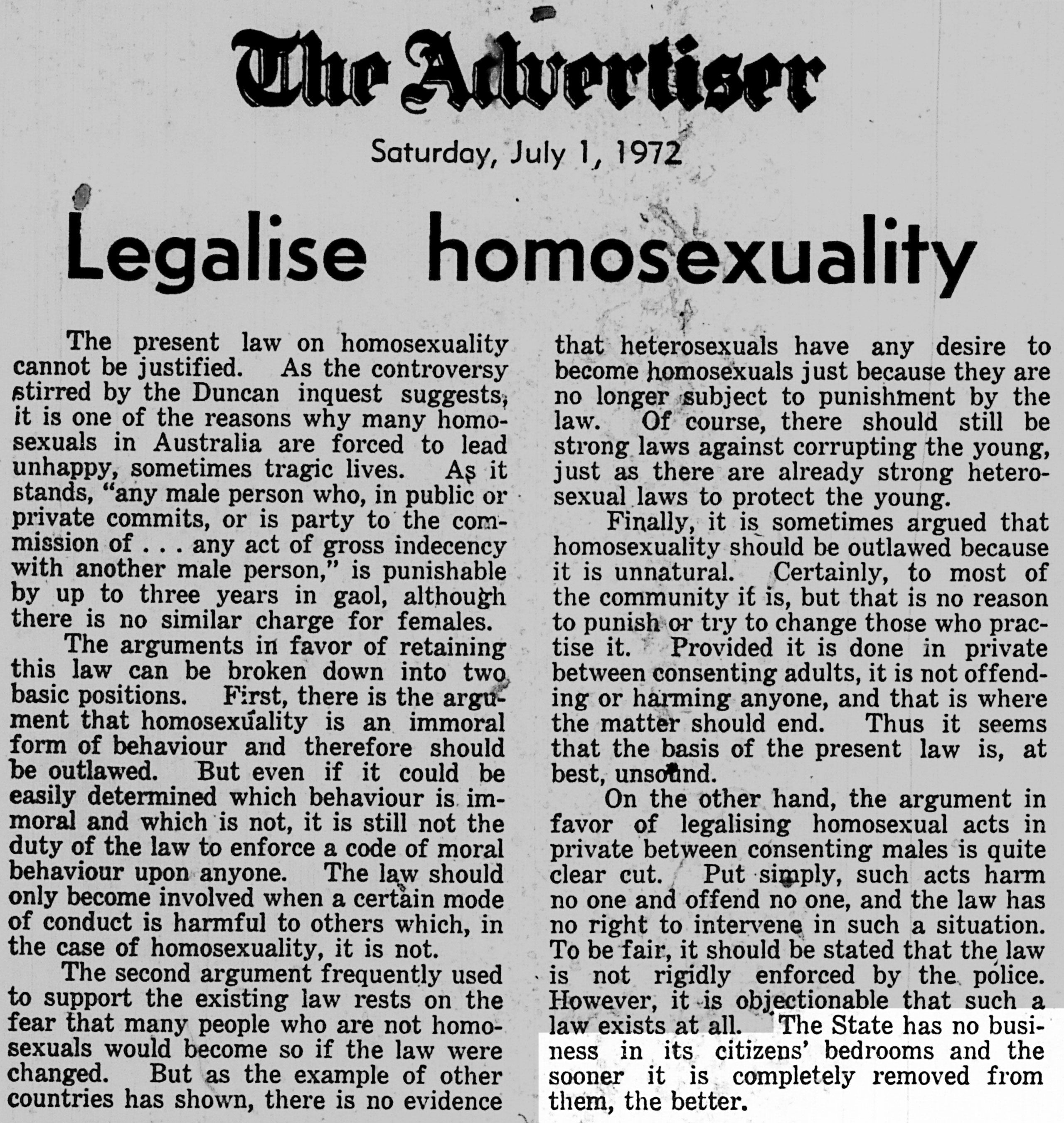
Advertiser, 1 July 1972
Advertiser, 1 July 1972
The Advertiser, under its progressive editor, Des Colquhoun, would support gay law reform until its eventual success.
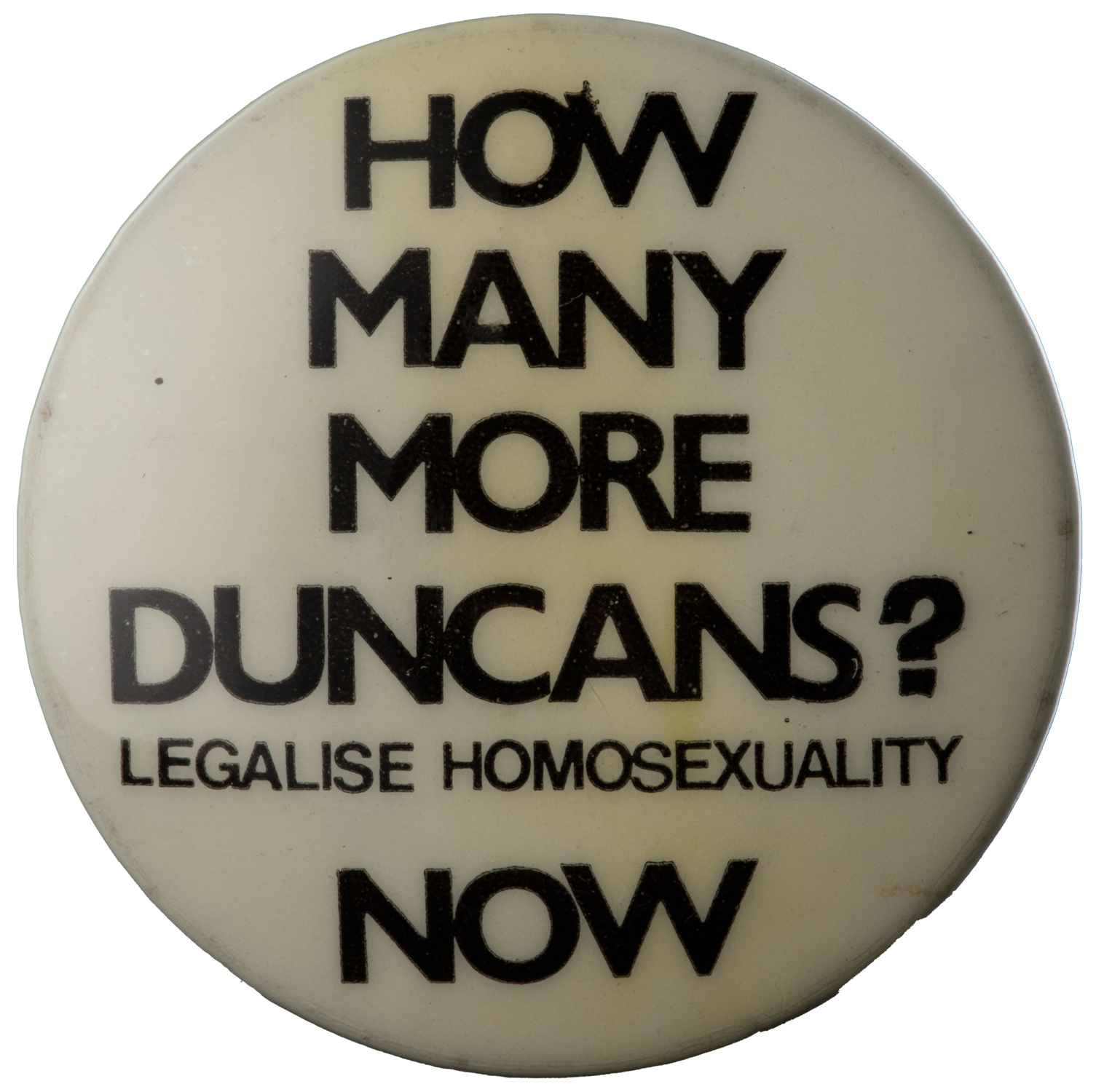
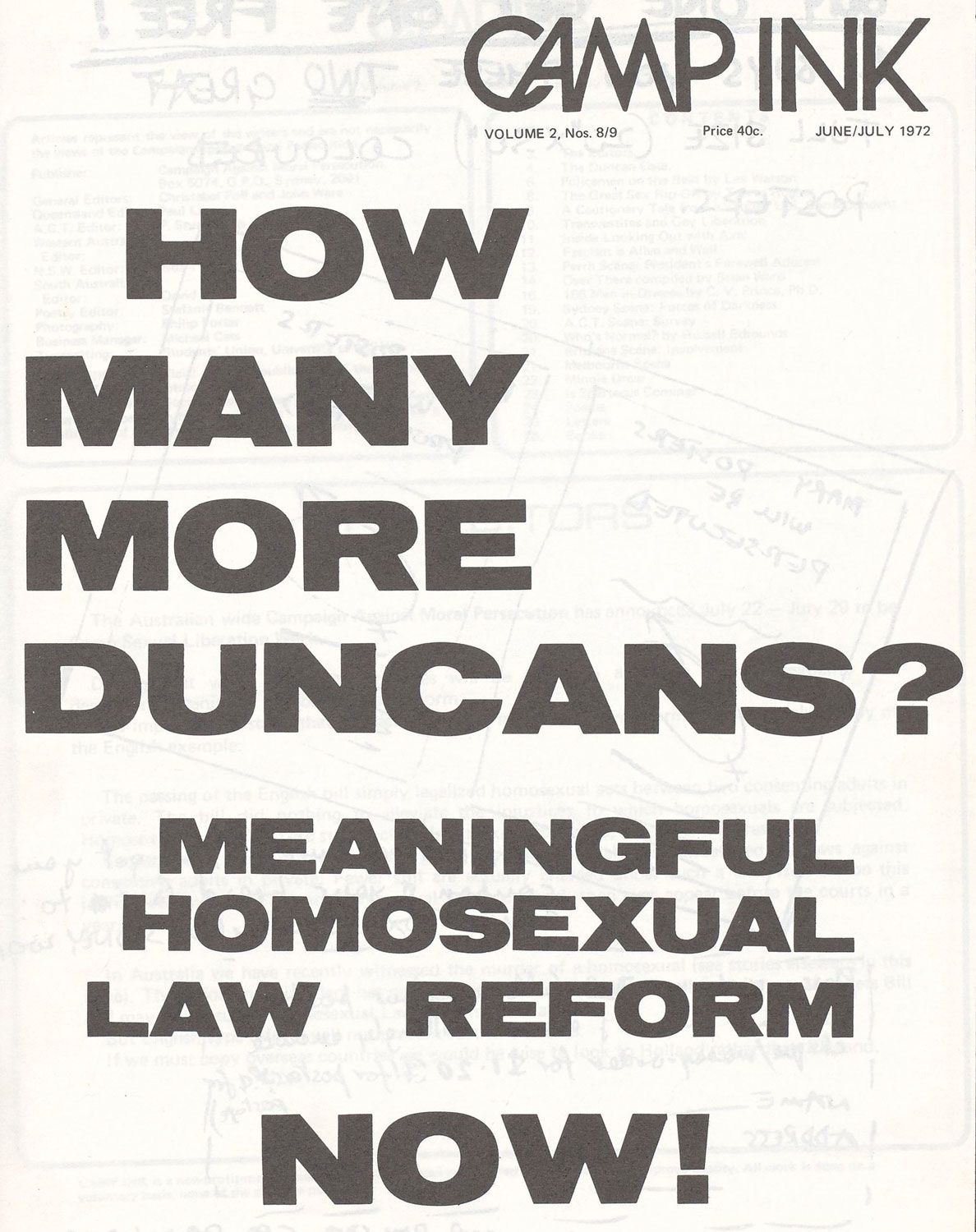
CAMP also seized the initiative. It issued its regular newsletter with a bold front cover, and printed badges.
|
CAMP badge. SLSA: D 8754(L)/24 CAMP badge. SLSA: D 8754(L)/24 |
Camp Ink, June/July 1972 SLSA: D 8754(L)/21 Camp Ink, June/July 1972 SLSA: D 8754(L)/21 |



July 1972
An unexpected announcement
A member of the conservative side of politics champions gay law reform
Less than two months after the death of Dr Duncan, Murray Hill, a Liberal and Country League member of the state's Legislative Council, announced he would introduce a Private Member’s Bill to enact gay law reform. The Bill was Hill’s own initiative and did not have his party’s official backing.
This was something that Labor - the progressive party headed by now Premier Don Dunstan - had not even been able to achieve.

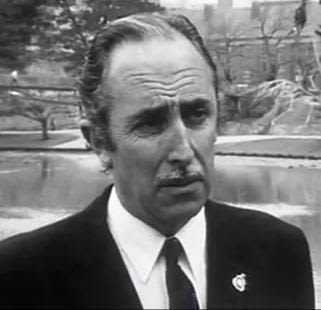
Murray Hill being interviewed. This Day Tonight, ABC, 19 July 1972
Murray Hill being interviewed. This Day Tonight, ABC, 19 July 1972
Hill's Bill, modelled on Britain’s 1967 legislation, aimed to decriminalise private sexual acts between two consenting adult men over the age of 21. This was even though the legal age of adulthood in South Australia was 18, and women could consent at 17.
Of the Bill, Hill said it ‘certainly would not seek to put the seal of moral approval on homosexuality as such, nor would it condone this sort of behaviour’. This seemed harsh and judgemental, but he was likely trying to attract support from his colleagues and the broader community.
Hill demonstrated courage and leadership, and is the hero of the law reform events of 1972.

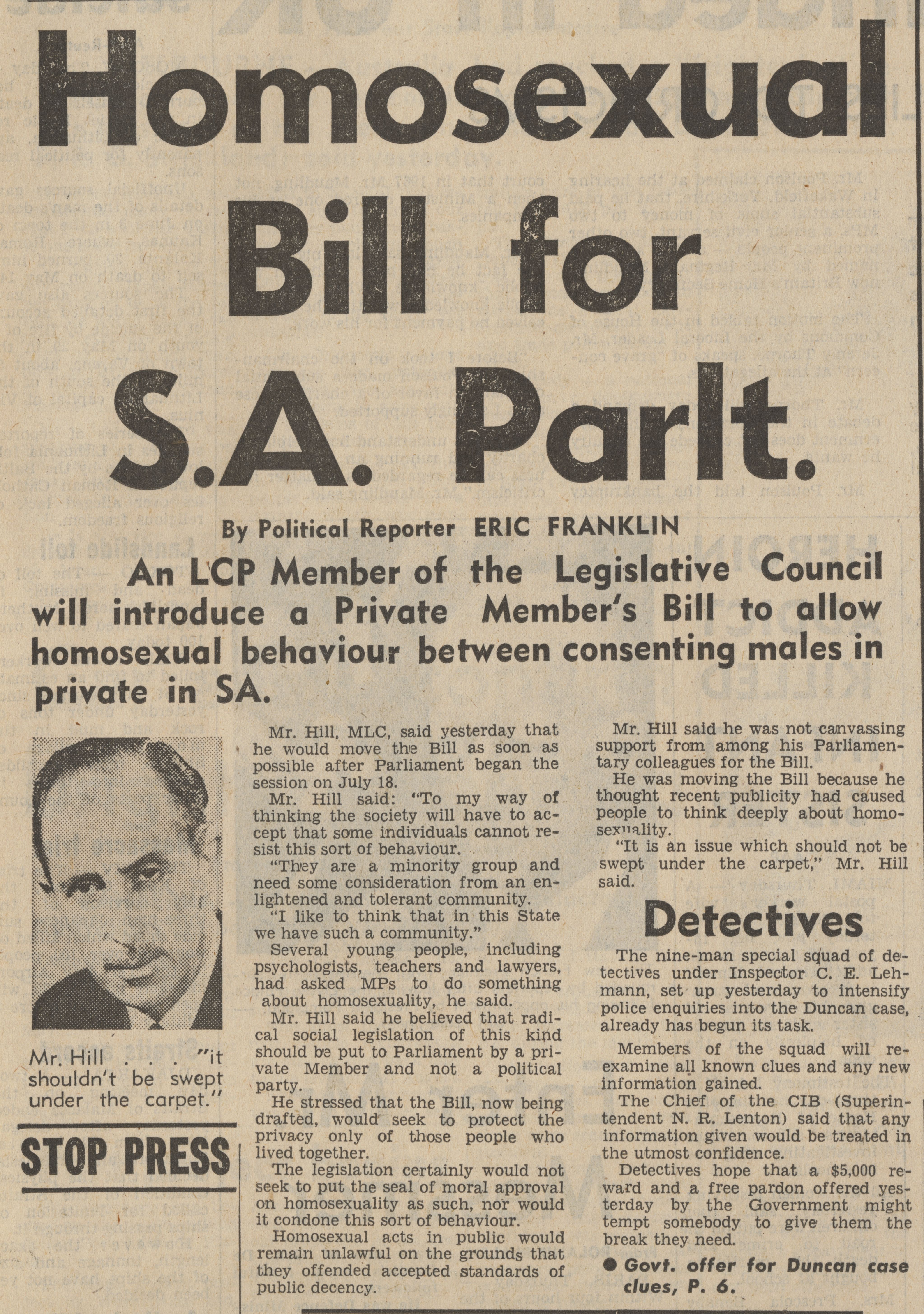
Advertiser, 7 July 1972
Advertiser, 7 July 1972
August 1972
South Australia’s first gay law reform Bill is introduced
Parliamentarians on both sides are allowed a conscience vote
The South Australian Parliament has two chambers - the Legislative Council or Upper House, and the House of Assembly or Lower House. A Bill must pass both Houses, and then be assented to by the state's governor, to become law.

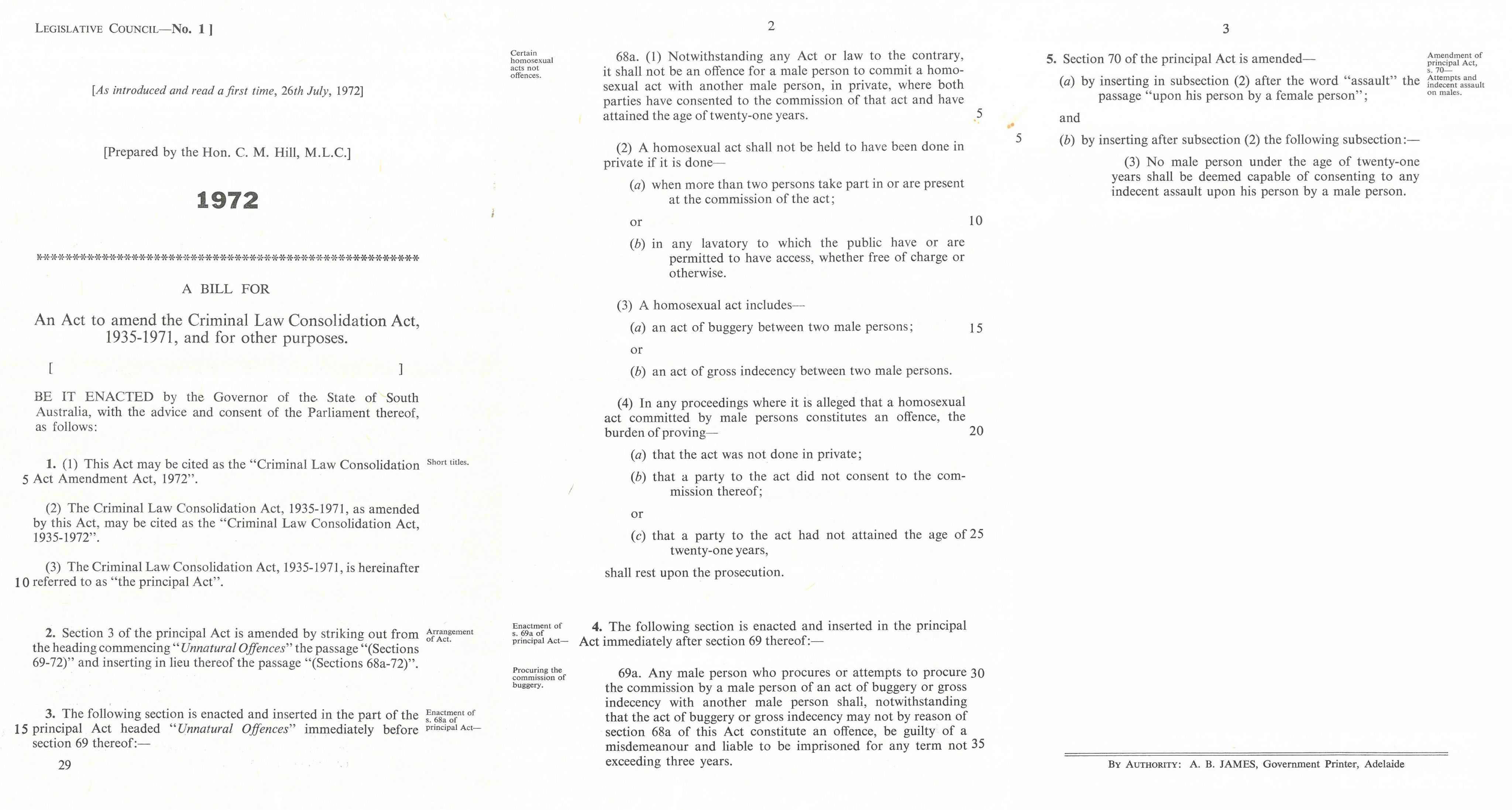
Murray Hill's Bill. SLSA: D 8754(L)/18
Murray Hill's Bill. SLSA: D 8754(L)/18
CAMP was told the Hill Bill would have an easy run in the Labor-controlled House of Assembly. However, the Legislative Council was dominated by Liberal and Country League members, many of whom were cautious or opposed. Hill himself would be lobbied heavily by a variety of organisations, including supporters like CAMP, and opponents. These included religious and 'moral' groups like the Community Standards Organisation, Moral Action Committee and Moral Re-Armament.
In his introductory speech in the Legislative Council on 2 August 1972, Hill said:
'In this state, a challenge has come to our often-expressed claims, that we, within the nation as a whole, are a tolerant and socially understanding people; that challenge came as a result of the Duncan inquiry and the public discussion that followed'
View the full speech below:
July - October 1972
Debates in Parliament
Parliamentarians grapple with what is bold social legislation
The suddenness of Dr Duncan’s death and Murray Hill’s Bill meant CAMP struggled to educate members of Parliament.
During debate, Hill himself used awkward metaphors, referring to ‘these men with a limp’ who ‘wait for help on the roadside of life’. Another parliamentarian noted that ‘like alcoholism, mental derangement and adultery, this is not a palatable subject to discuss’.

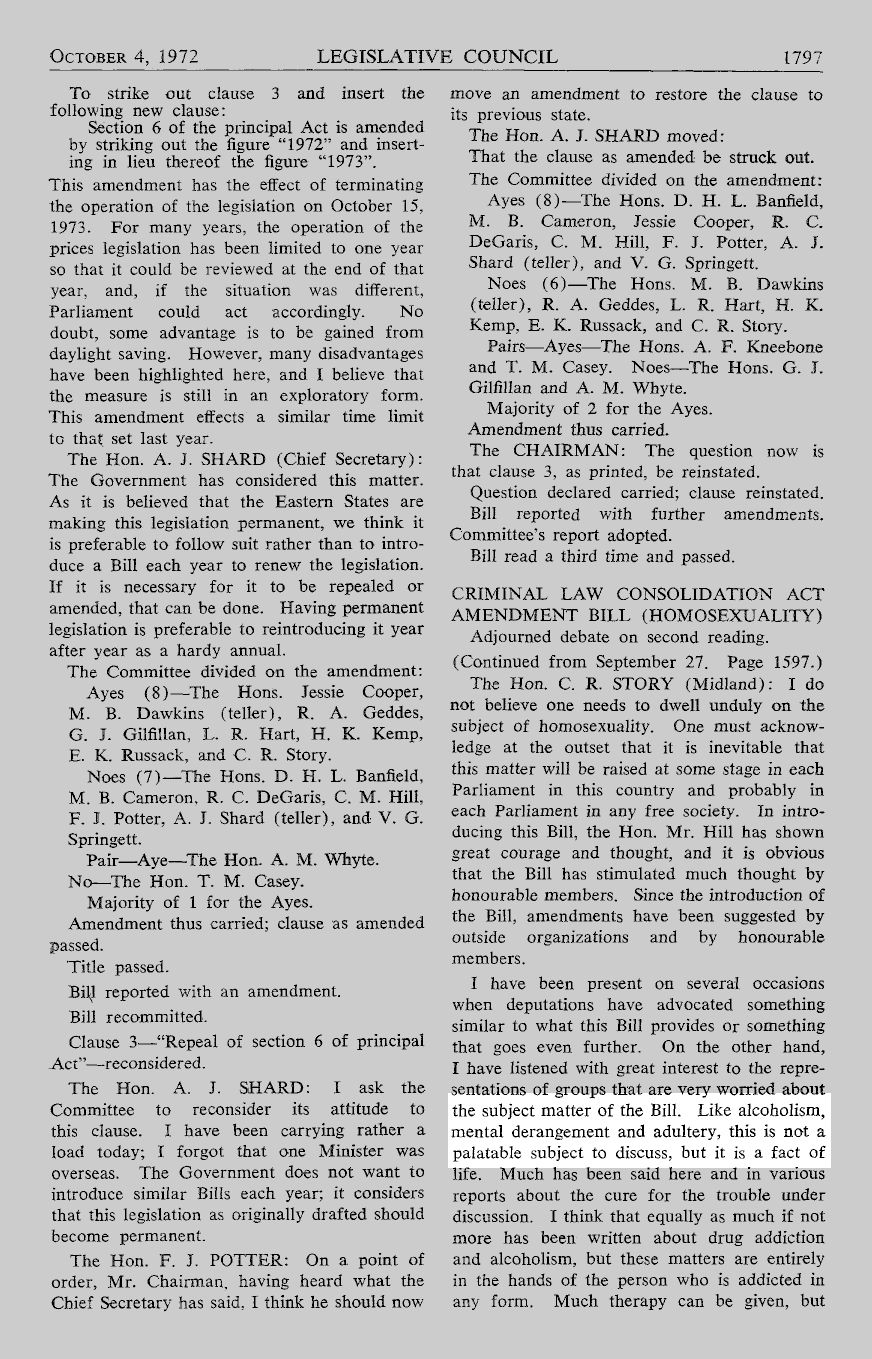
South Australian Parliamentary Debates, Legislative Council, 4 October 1972
South Australian Parliamentary Debates, Legislative Council, 4 October 1972
The Catholic Attorney-General, Len King, described male homosexual acts as ‘a perverted activity’ and ‘intrinsically evil’, yet he supported the Bill.
Those opposing reform were more emotive. One argued that relaxing the laws would increase the incidence of homosexuality and even predicted that homosexual marriage would follow within ten years. It took 45 years.
July - October 1972
Debates in the media
The South Australian community has its say
Members of Parliament and the media were inundated with letters from the public. Supporters of reform were outnumbered by opponents, who mainly justified their position using religious arguments.
'God, in his Holy Word, has set down moral rules for mankind, and if man deliberately and defiantly disobeys, then he will destroy himself'
The Reverend David L White fumed that homosexuality ‘is NOT normal! It is a sexual aberration, a perversion which the Living Word of God calls an “abomination” before God.’
These views were challenged by Margaret Ferrie, who described the scriptures as ‘an historical account of bygone centuries’ and asked: ‘Surely there is such a thing as progress and reform.’ CAMP’s Roger Knight supported her, arguing that the beliefs of Old Testament fundamentalists should not be ‘the basis for law-making in a secular society’.

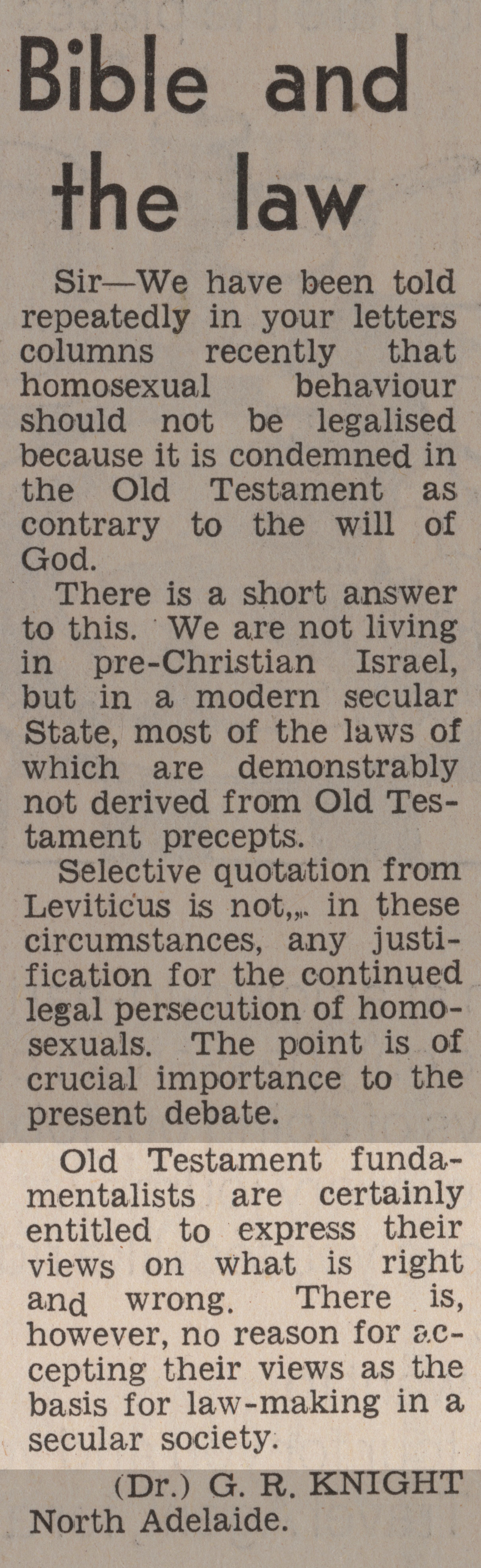
From Advertiser letters to the editor, 8-18 July 1972
From Advertiser letters to the editor, 8-18 July 1972
Overall, letter writers to the Advertiser were two-to-one against reform.
October 1972
An amended Bill is passed
Hill's Bill is significantly weakened
Ren DeGaris was the leader of the conservatives in Murray Hill's own party in the Legislative Council. On 11 October, DeGaris successfully introduced an amendment such that a private, consensual act between two men over 21 would exist only as a defence in court. It gave the appearance of reform while keeping male homosexual acts technically criminal.
In the House of Assembly, Hill's Bill was restored to its original charter but with a reduced age of consent of 18. This was promptly rejected by the Council. After consulting with CAMP, Labor decided not to escalate the issue. The Hill Bill with the DeGaris amendment passed both Houses of Parliament on 25 October, and was assented to by the Governor on 9 November.
While supporters had hoped for more meaningful change, this became the first tentative step towards gay law reform in South Australia. Within the year, another attempt would be made.

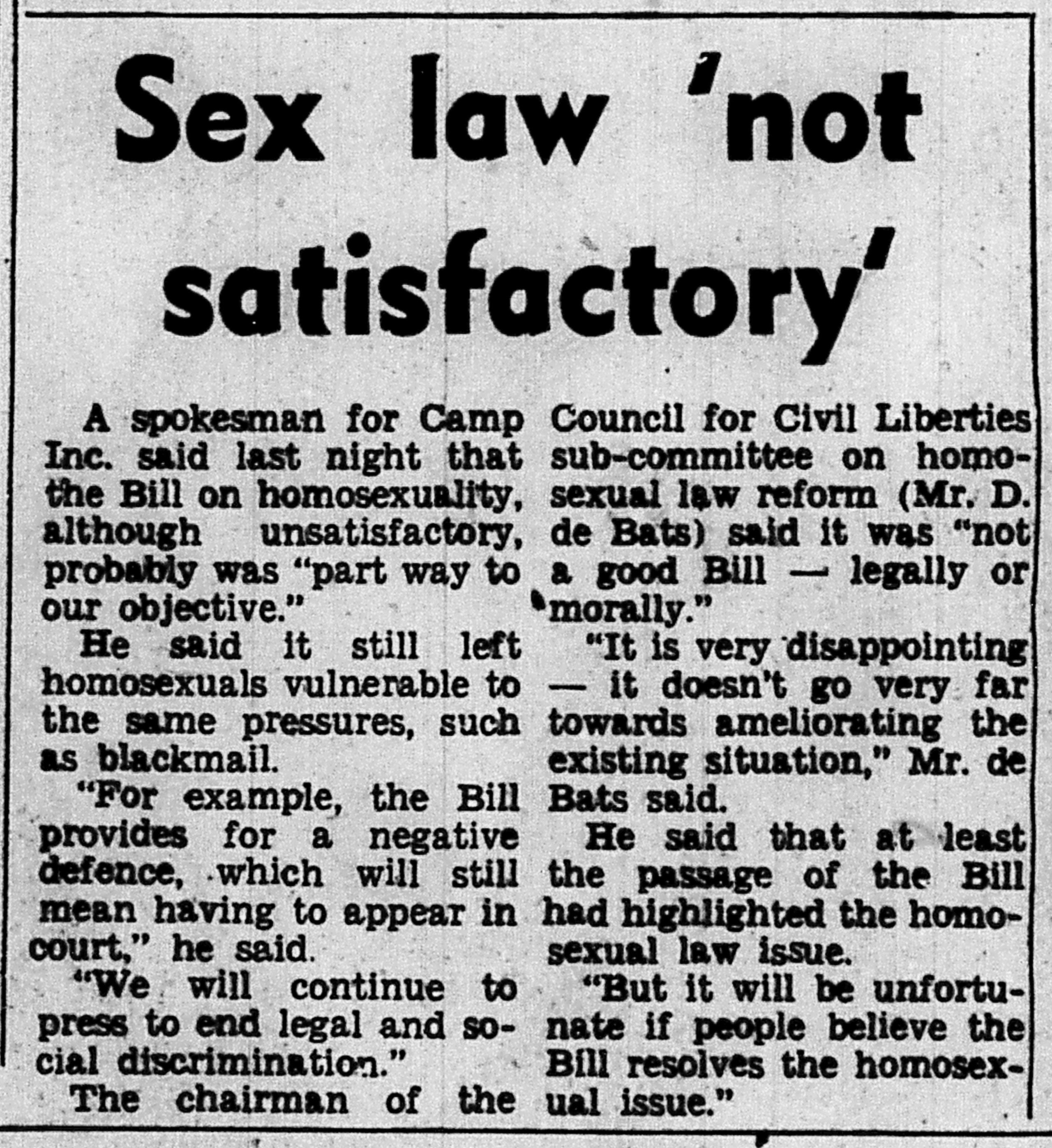
Advertiser, 26 October 1972
Advertiser, 26 October 1972



March 1973
Peter Duncan steps forward
A new reform advocate emerges from the Labor Party
The 1973 election in South Australia only slightly reduced the Liberal and Country League Party majority in the Legislative Council. The Party was the main barrier to gay law reform.
Peter Duncan (no relation to Dr Duncan), aged only 28, had been elected as member for the seat of Elizabeth. At university he had learnt about ‘victimless crimes’. Acts such as public drunkenness, loitering, prostitution, euthanasia, censorship and homosexual conduct between consenting adults – which he believed should not be criminalised.

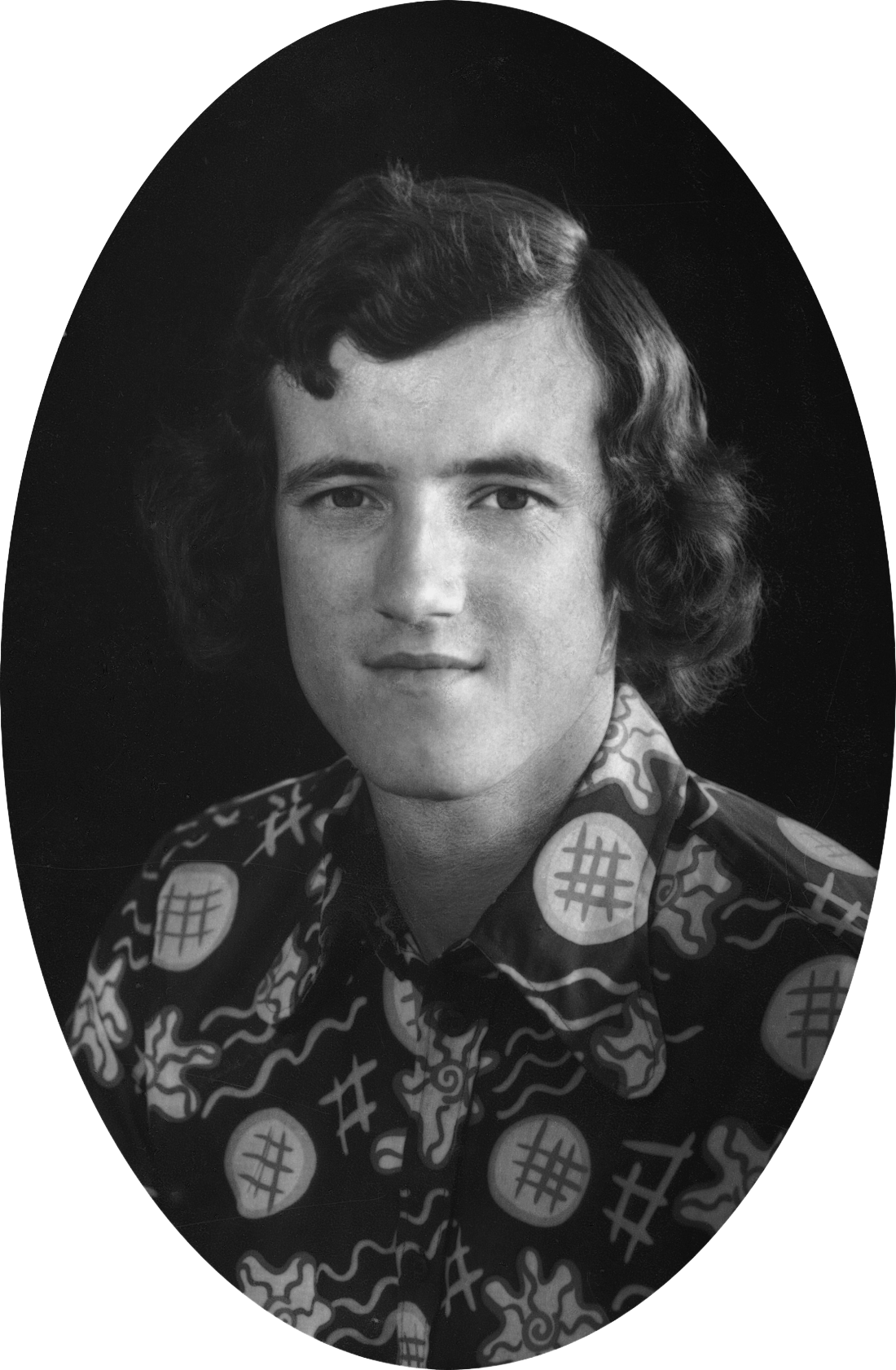
Peter Duncan, 1973. Courtesy of the House of Assembly, Parliament of South Australia
Peter Duncan, 1973. Courtesy of the House of Assembly, Parliament of South Australia
'Frankly, it appalled me that a class of otherwise law-abiding citizens should be subjected to the criminal law for behaviour that had no social impact except maybe to offend the sensibilities of some individuals'
Shortly after his election, Duncan received a letter from the South Australian Council for Civil Liberties urging him to act on gay law reform. He began drafting his own Private Member’s Bill.
15 September 1973
Adelaide’s first ‘Proud Parade’
Gay and lesbian activism takes to the streets
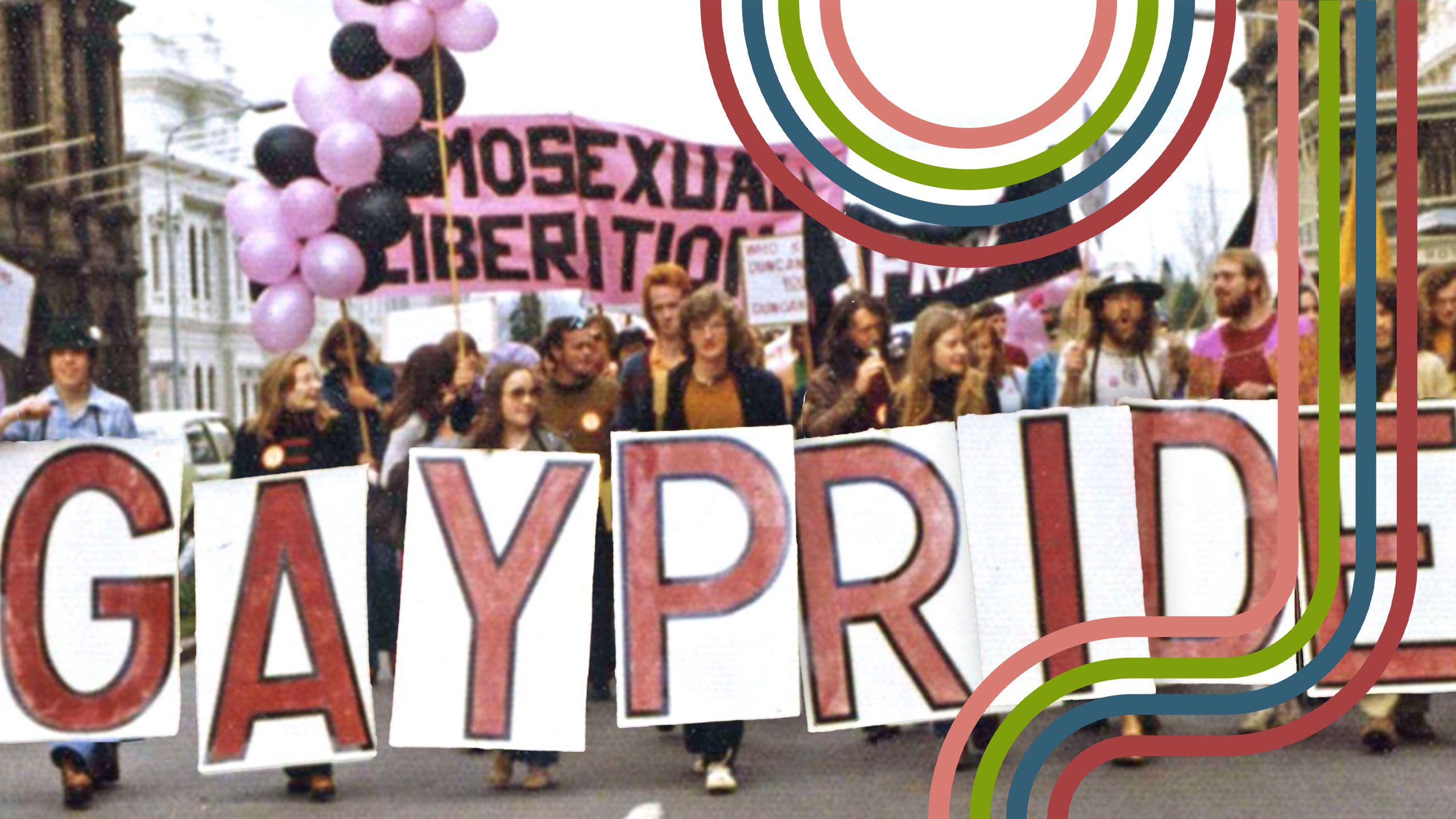
In September 1973, cities around Australia marked Gay Pride Week, with marches a central feature. On 15 September, around 11am, a crowd gathered at Tarntanyangga/Victoria Square for Tarntanya/Adelaide’s first ‘Proud Parade’. The route followed down King William, Grenfell and Pulteney Streets, then into Rundle Street (then a busy shopping street before becoming a mall in 1976). The city got its first bold, celebratory taste of gay and lesbian liberation.

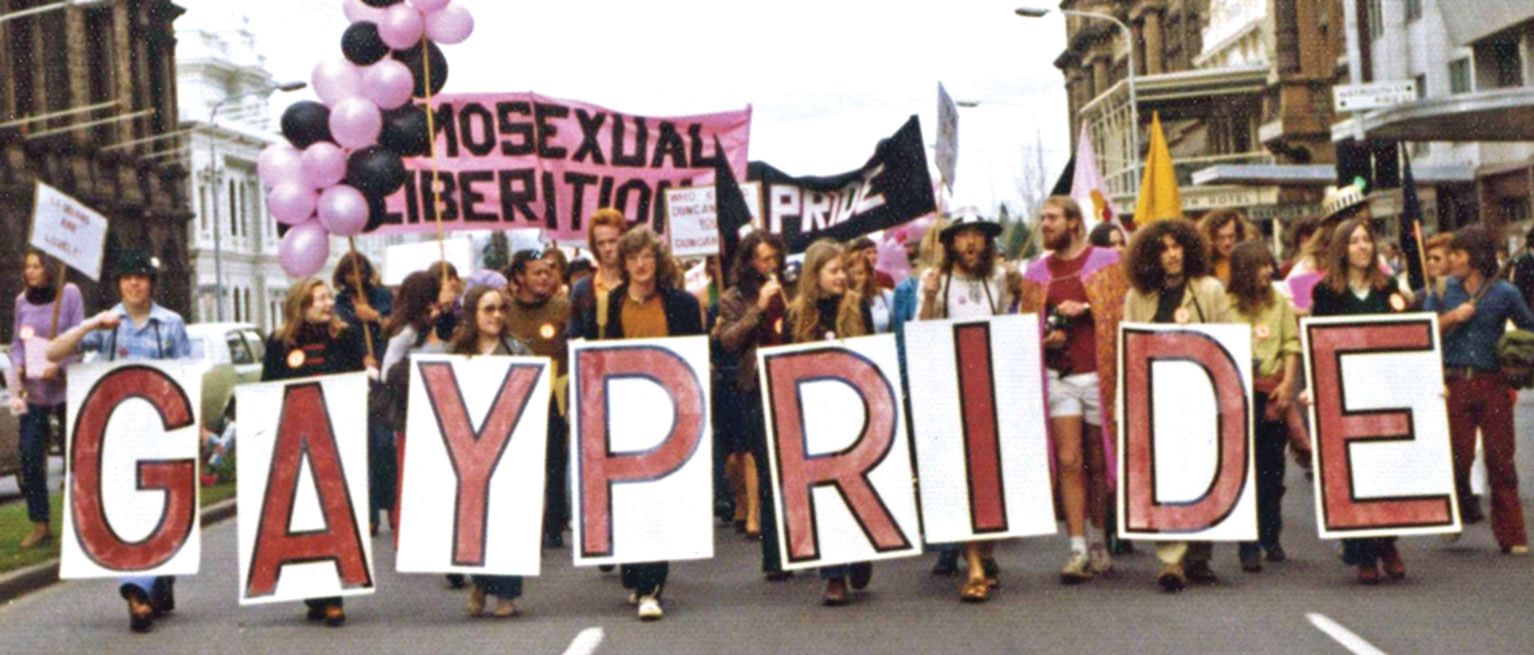
Proud Parade, Adelaide, 15 September 1973. Courtesy of Professor Jill Julius Matthews and History Trust of South Australia
Proud Parade, Adelaide, 15 September 1973. Courtesy of Professor Jill Julius Matthews and History Trust of South Australia
The parade was led by eight people carrying signs spelling out ‘GAY PRIDE’, accompanied by flags, balloons and banners. A special anthem was sung, written to the tune of The Teddy Bears’ Picnic. There was also provocative chanting: ‘2, 4, 6, 8, Gay is twice as good as straight! / 3, 5, 7, 9, Try it our way just one time!’

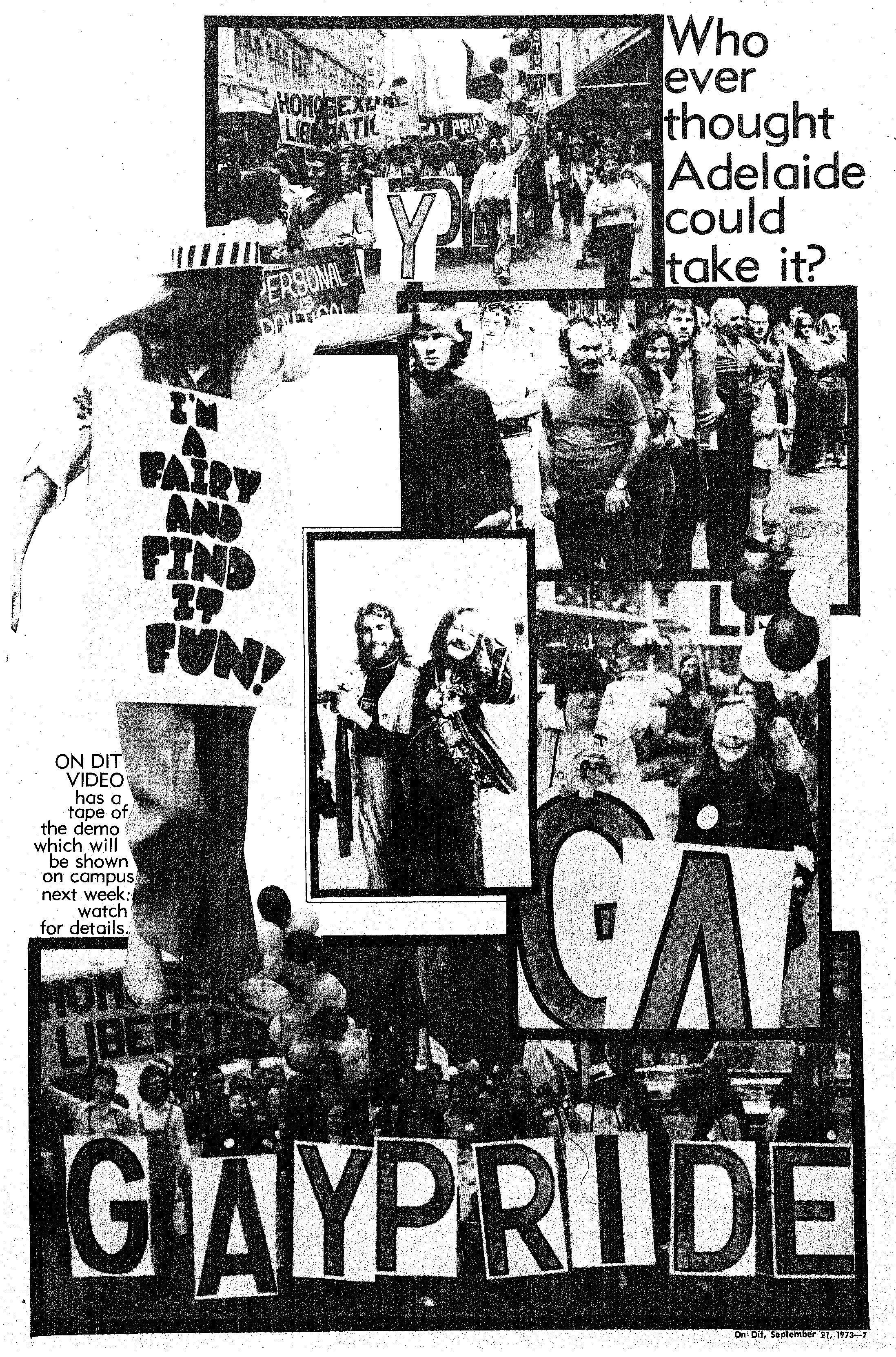
On Dit, 21 September 1973. Courtesy University of Adelaide Archives
On Dit, 21 September 1973. Courtesy University of Adelaide Archives
Meanwhile, developments had been building on the political front. Just four days later, Parliament would begin debate on the second attempt at gay law reform in South Australia.
19 September 1973
South Australia’s second gay law reform Bill is introduced
The House of Assembly begins debate
Peter Duncan spoke to his Bill. It was significantly different to Hill’s 1972 Bill, which had been introduced into the Legislative Council. Duncan’s provided for what he described as ‘a code of sexual behaviour’ applicable to all persons regardless of sexual orientation or gender. In creating statutory equality between homosexuals and heterosexuals, it established a common age of consent of 17 (compared with 21 for homosexuals in the 1972 Bill), the same penalties for non-consenting acts and the same restrictions on public acts, and penalties.
This was far-sighted legislation, from the man who would soon be appointed South Australia's youngest Attorney-General.

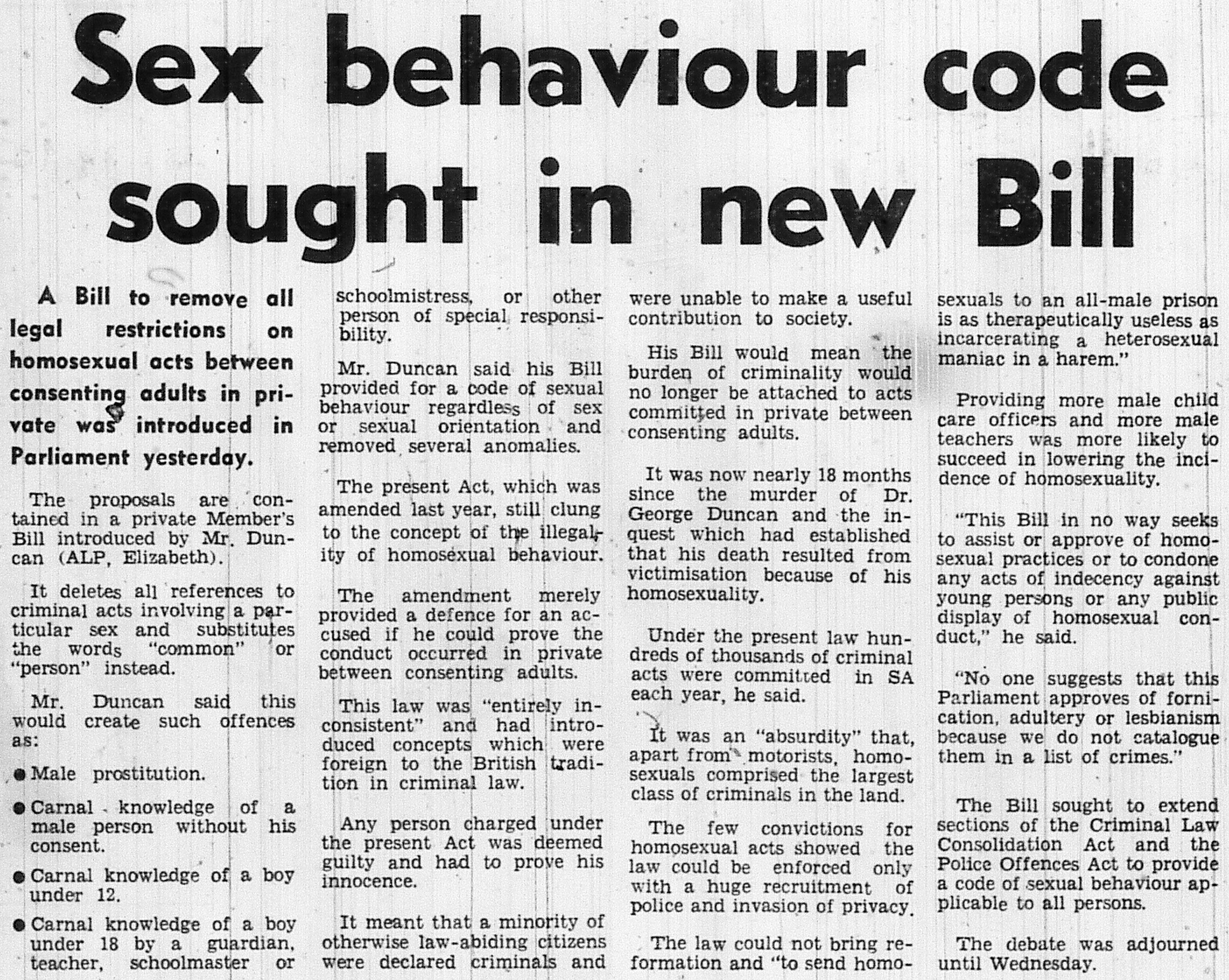
Advertiser, 20 September 1973
Advertiser, 20 September 1973
November 1973
Parliamentary debate sours
The Bill founders
After Duncan’s Bill was introduced, campaigners on both sides lobbied members of Parliament. The Bill passed quickly in the House of Assembly, but the Legislative Council once again proved far more cautious.
Controversy flared with reports that a new lobby group, Gay Activists Alliance, proposed to give talks to secondary school students. Some Councillors believed that activists were trying to promote homosexuality to young people. Gordon Gilfillan warned it would ‘spread there’, while Richard Geddes, initially supportive, switched to opposition.
Reformers had hoped Labor MLC Tom Casey would support the Bill. Instead, he declared:
'I emphasize very strongly indeed that homosexuality is not, as certain Gay Activist groups would have it, the lifestyle of the future … I believe that under existing legislation homosexuals have a freedom which has been denied to them for many years … To go further (as is attempted in this Bill) will put our youth and moral decency that we respect in our community at a distinct disadvantage. It is for those reasons that I cannot support the Bill'
On 21 November, the Bill was put to the vote and defeated. A Labor member, Cec Creedon, who supported the Bill, failed to vote as he claimed he did not hear the bells ringing for the division. The Bill was reintroduced a week later under a rarely used Standing Order, but defeated for the second and final time on the deliberative vote of the Council's President. South Australia came so close.
After the Bill's defeat, the Labor Party in South Australia formally declared its support for gay law reform at a 1974 State Council meeting. However, it would be another year before the final attempt was made.



12 July 1975
The 1975 election brings change
New members shift the balance in favour of reform
An early election held 12 July 1975 returned the Dunstan Labor Government to power. While the Party held only a one-seat majority in the House of Assembly, the real change was in the Legislative Council.
Under a more democratic electoral system, half the Council faced the polls. Eight new members were elected, six from the Labor Party. As well, three opponents of gay law reform were no longer in the chamber.
In 1973, the Liberal and Country League Party had split, creating the Liberal Party and more progressive Liberal Movement.

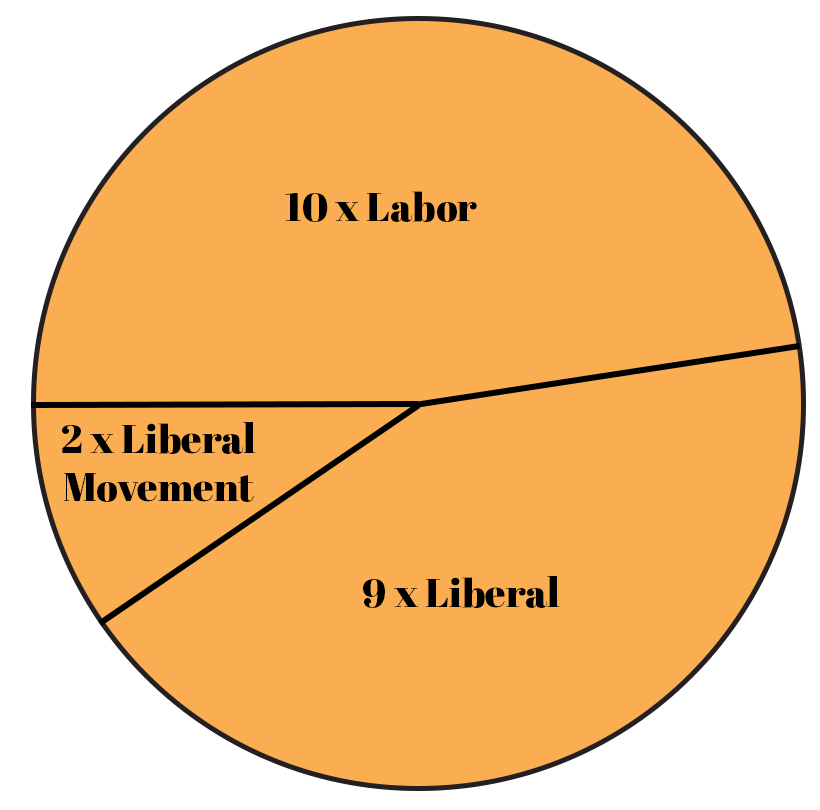
The state of the parties was described as 'not a government majority but a majority for electoral reform'.
27 August 1975
South Australia’s final attempt is made
Peter Duncan reintroduces his Bill
The new Opposition Leader, Dr David Tonkin, supported the Bill, as he had with earlier attempts. However, seven rural opposition members opposed it, and one tried to adjourn proceedings. Despite this, debate was brisk and the Bill passed in a single sitting with a majority of 19, backed by all Labor members, seven Liberals, and Robin Millhouse, the leader of the Liberal Movement.
The Bill gained further momentum when the newly appointed Anglican Archbishop of Adelaide, the Most Reverend Dr Keith Rayner, addressed gay law reform in his first Diocesan Synod. While he criticised what he saw as the glorification of homosexual life and said homosexual partnerships were not comparable to heterosexual marriage, the Advertiser highlighted his comments in a prominent page-one story.

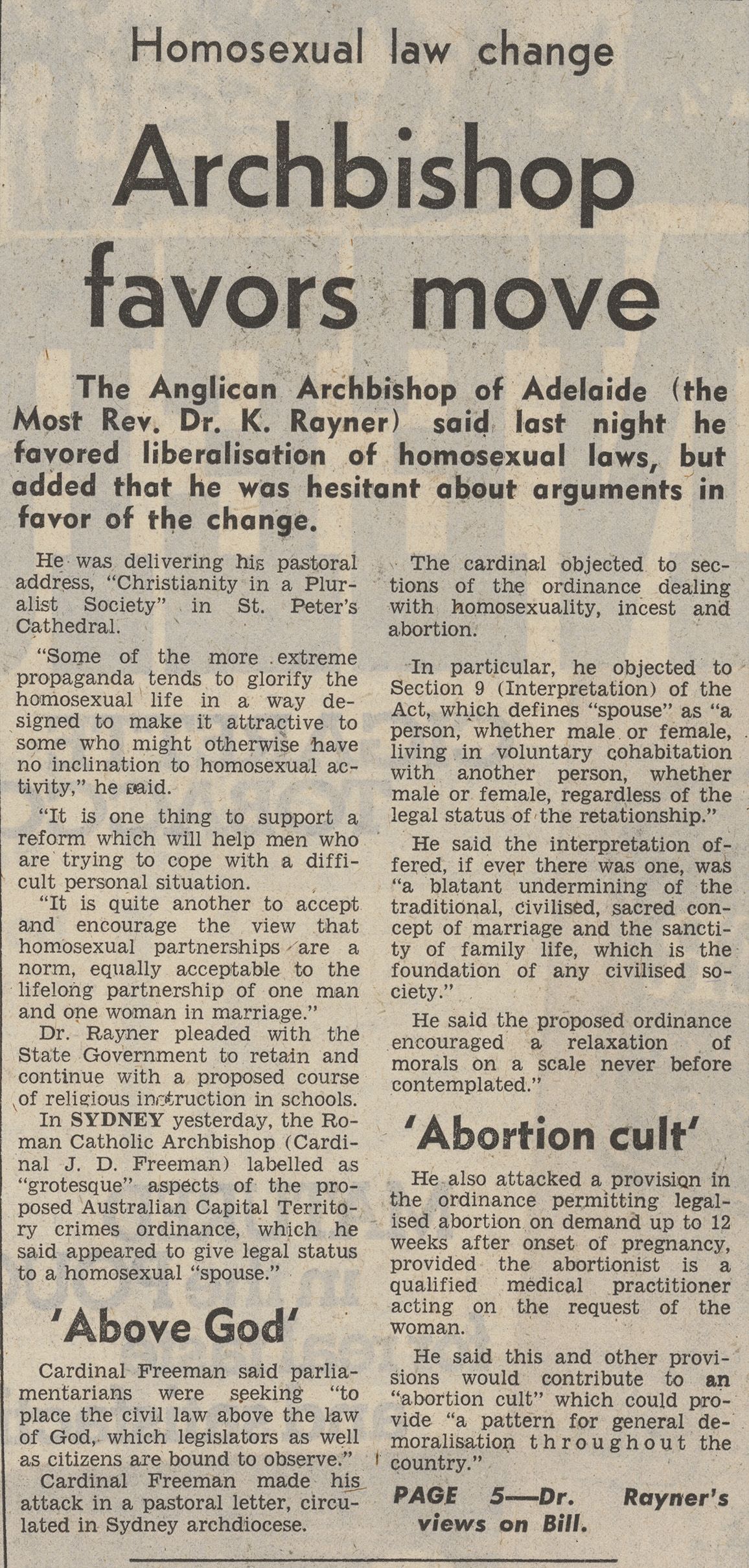
Advertiser, 2 September 1975
Advertiser, 2 September 1975
9 September 1975
The Bill reaches the Legislative Council
More voices join the debate
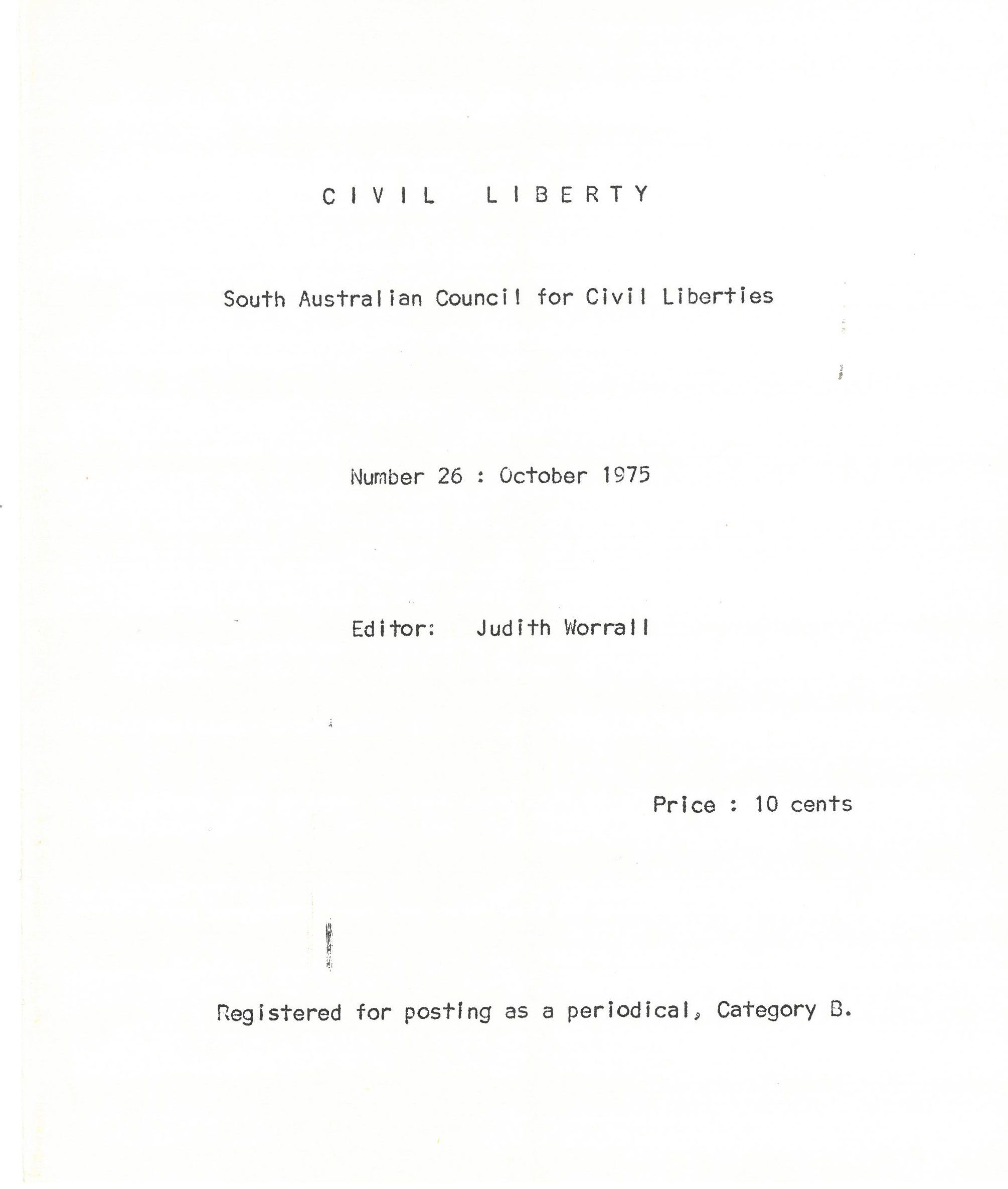
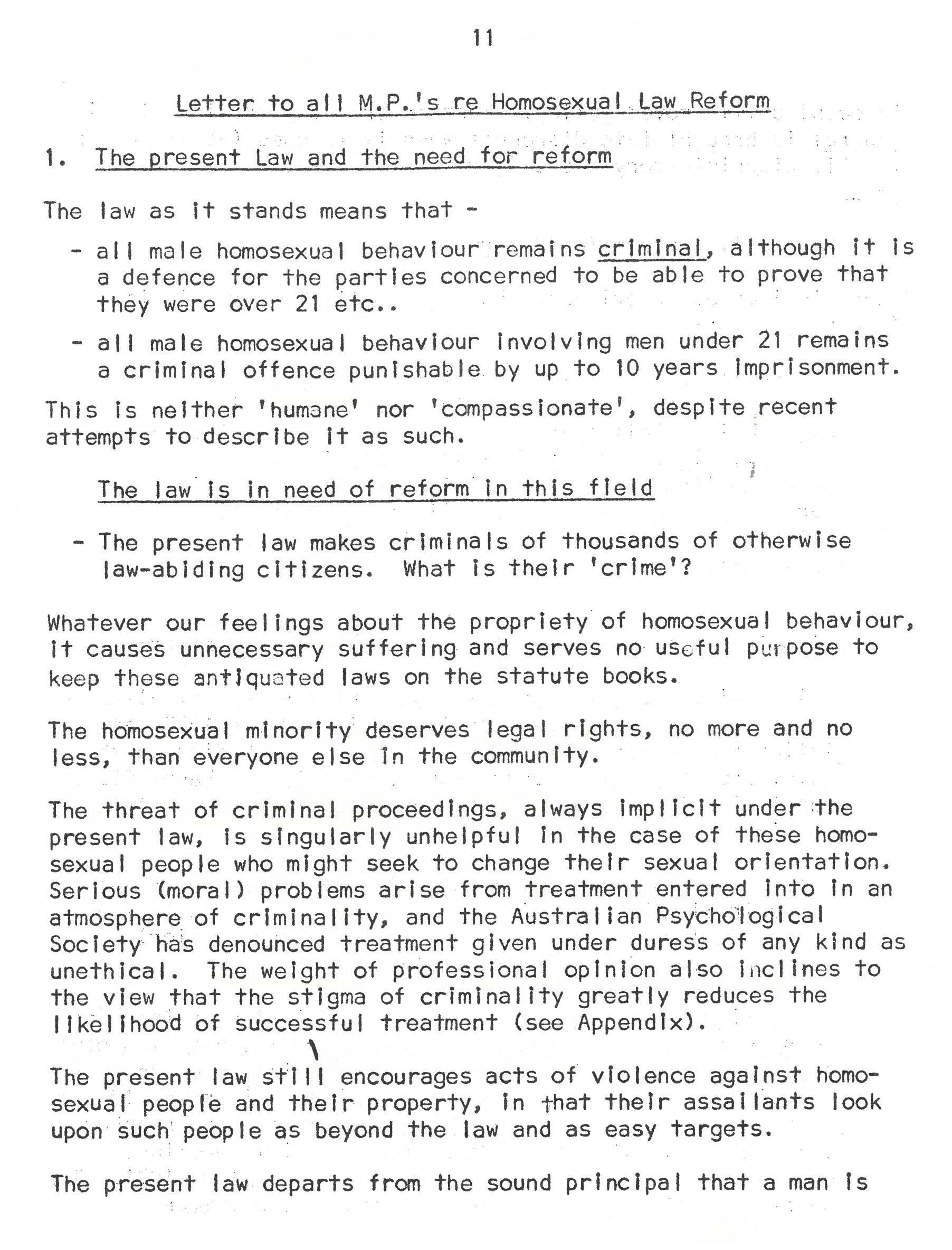
Letters backing reform were arriving from groups such as the South Australian Council for Civil Liberties and the Australian Psychological Society.
|
Civil Liberty, October 1975. SLSA: D 8754(L)/5 Civil Liberty, October 1975. SLSA: D 8754(L)/5 |
Civil Liberty, October 1975. SLSA: D 8754(L)/5 Civil Liberty, October 1975. SLSA: D 8754(L)/5 |


When Anne Levy introduced the Bill, she pointed out that many countries had modernised their laws on homosexuality, some over a century ago. She also highlighted the wide support for reform in South Australia, listing the influential churches (Anglican, Catholic, Congregational and Methodist), community groups, newspapers, and political and professional organisations.
Levy quoted opinion polls that showed a shift in attitudes. In 1967, only 22% of Australians supported decriminalisation. By mid-1974, however, a majority of 54% were in favour, while just 26% thought homosexual acts should remain illegal.
She also pushed back against one of the main arguments raised by religious groups like the Festival of Light, that the reform would harm the family unit in society:
'If objectors to this Bill were really consistent in their concern for maintaining family life, they should try to have adultery and fornication made crimes, as indeed they were in medieval times. Adultery will always cause far more marriages to founder than will homosexual practices, as our divorce courts have shown only too well'

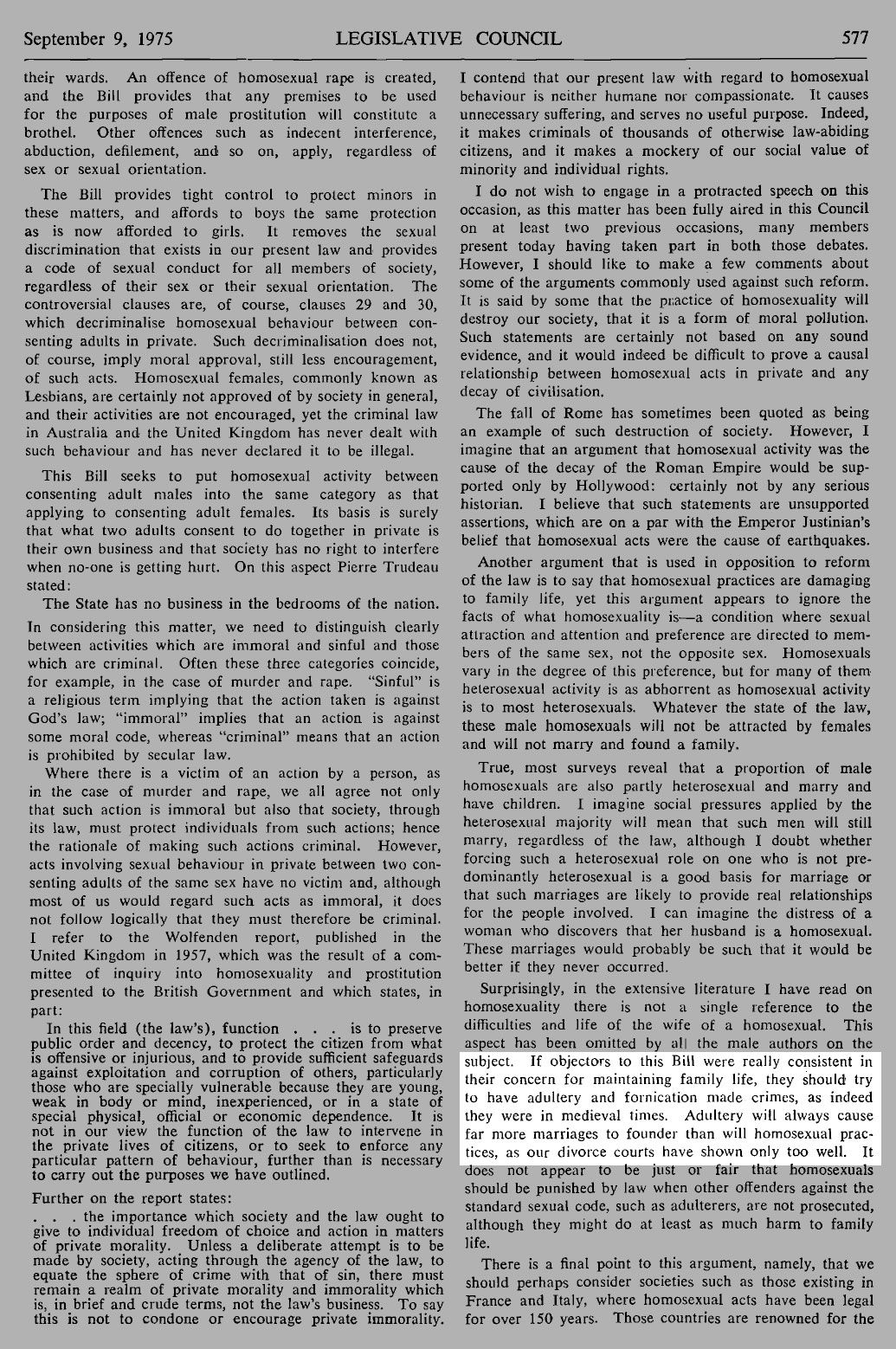
South Australian Parliamentary Debates, Legislative Council, 9 September 1975
South Australian Parliamentary Debates, Legislative Council, 9 September 1975
17 September 1975
Hanging in the balance
The Bill still faces hurdles
Some Legislative Councillors fell back on old arguments, with some recycling their 1973 speeches. They also revived fears about the now-defunct Gay Activists Alliance.
Tempers flared during debate when Labor’s Norm Foster interrupted an emotional speech to point at the Opposition benches and declare: 'How do I know that honourable members do not indulge, and how do they know that I do not?'
John Burdett introduced amendments that would have made it illegal to promote or encourage ‘unnatural sexual practices’ in schools or through advertising. His proposal played on old fears about homosexuals recruiting others. If these amendments divided the Bill’s supporters, it risked collapse altogether.

17 September - 2 October 1975
The Bill is passed and becomes law
History is made with South Australia leading the nation
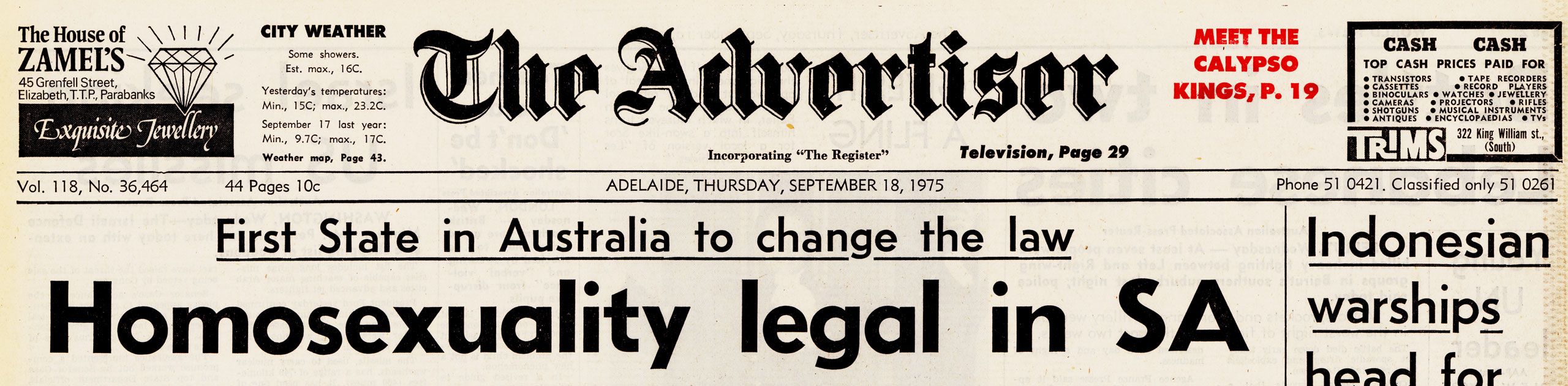
After continued debate in the Legislative Council, and the rejection of proposed amendments, the Bill formally passed on 17 September 1975. The Bill had passed both Houses of the South Australian Parliament, and now awaited assent from the governor.

Advertiser, 18 September 1975
Advertiser, 18 September 1975
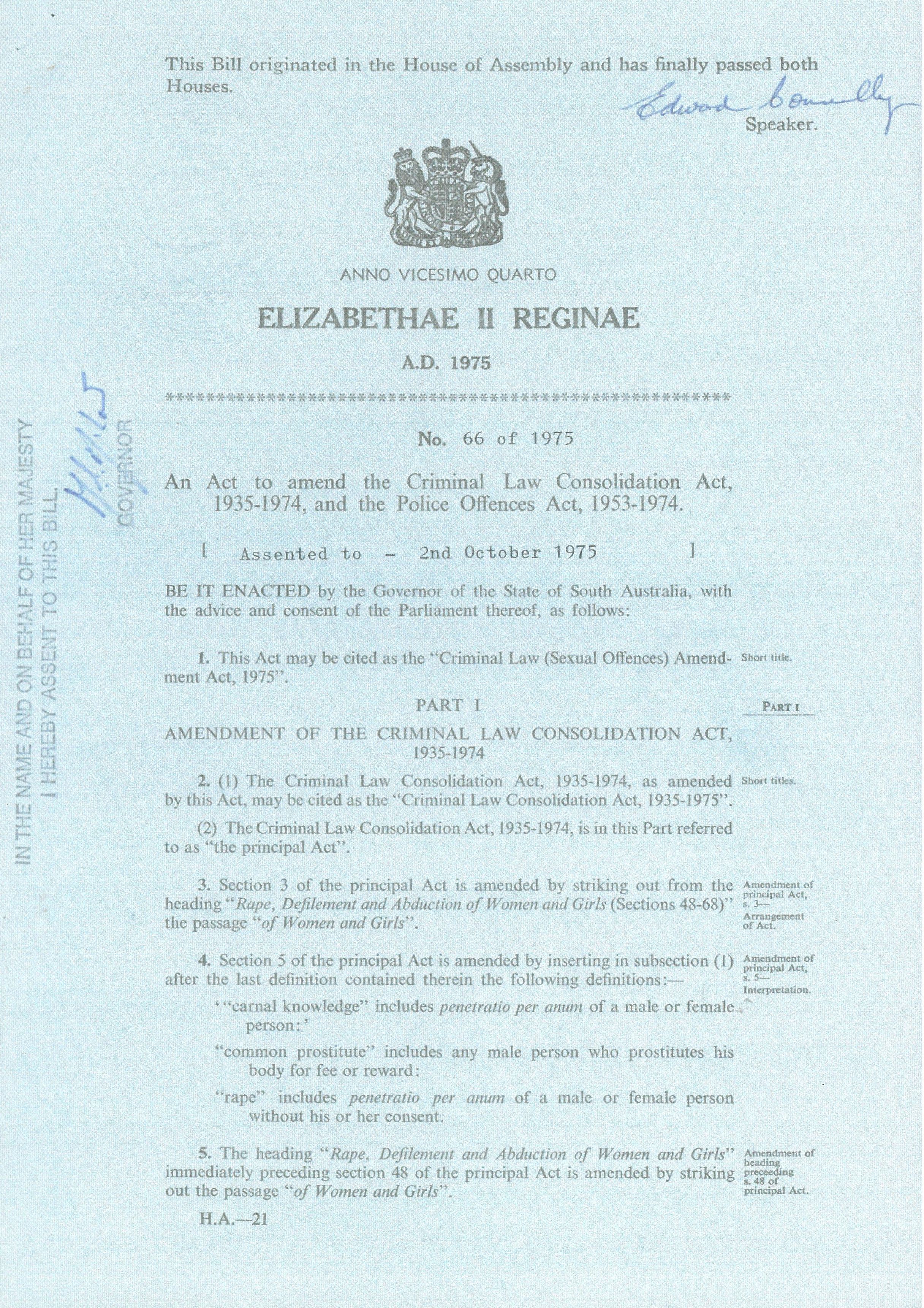
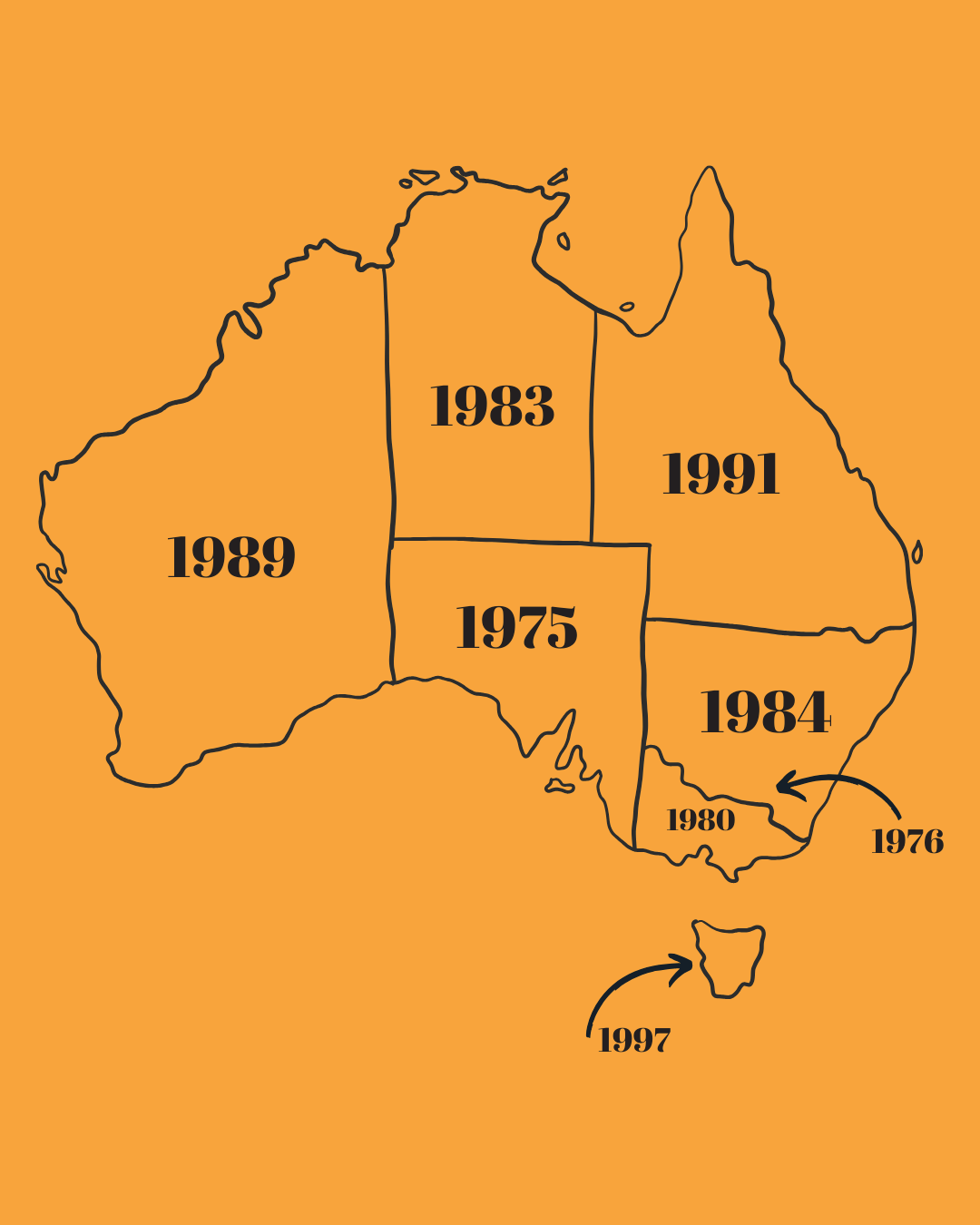
The Act to amend the Criminal Law Consolidation Act, 1935-1974, and the Police Offences Act, 1953-1974 was signed into law by the South Australian Governor, Sir Mark Oliphant, on 2 October 1975. South Australia thus became the first state or territory in Australia to decriminalise male homosexual acts.

The 1975 Act, assented to by South Australian Governor, Sir Mark Oliphant
The 1975 Act, assented to by South Australian Governor, Sir Mark Oliphant
1976 - 1997
Other jurisdictions
South Australia's lead is followed over a period of 22 years




1975 - 2024
Subsequent reform in South Australia
The state follows with further related social reform and strategies
- Sex Discrimination Act (1975)
- Equal Opportunity Commissioner (1975)
- Equal Opportunity Act (1984)
- Statutes Amendment (Domestic Partners) Act (2006)
- South Australian Strategy for the Inclusion of LGBTIQ People (2014)
- Statutes Amendment (Gender Identity and Equity) Act (2016)
- Statutes Amendment (Abolition of Provocation and Related Matters) Act (2020)
- Conversion Practices Prohibition Act (2024)


 Built with Shorthand